First record of Euzophera alpherakyella Ragonot, 1887 (Lepidoptera: Pyralidae: Phycitinae) from Uzbekistan
Malikjon R. Shermatov1,
Muminjon M. Mukhammedov1,
Oygulkhon I. Kayumova1,
Elyor A. Botirov1,
Gulnara S. Mirzaeva2,
Sardorbek Q. Kimyonazarov2
1 Department of Zoology and General Biology, Faculty of Life Sciences, Fergana State University, Fergana, 150100, Uzbekistan
2 Institute of Zoology of the Academy of Sciences of the Republic of Uzbekistan, 232b, Bogishamol St., Tashkent, 100053, Uzbekistan
Corresponding author: Malikjon Shermatov (malikjonshermatov@gmail.com)
Citation: Shermatov MR, Mukhammedov MM, Kayumova OI, Botirov EA, Mirzaeva GS, Kimyonazarov SQ (2025) First record of
Euzophera alpherakyella Ragonot, 1887 (Lepidoptera: Pyralidae: Phycitinae) from Uzbekistan. Acta Biologica Sibirica 11: 663–668.
https://doi.org/10.5281/zenodo.15347333
Abstract
This study presents the first confirmed record of Euzophera alpherakyella Ragonot, 1887 (Lepidoptera: Pyralidae: Phycitinae: Phycitini) from Uzbekistan. The species was identified based on two specimens collected from the Chimgan foothills in the southern part of the Fergana Valley. In addition to a detailed morphological description of adult moths, diagnostic images of the male and female genitalia are provided to support the identification of the species.
Keywords
Phycitinae, Euzophera alpherakyella, Elaeagnus, first record, Uzbekistan, Fergana Valley, Chimgan
Introduction
The Euzophera Zeller, 1867 belongs to the subfamily Phycitinae within the family Pyralidae. The Phycitinae is the largest subfamily, consisting mostly of small moths around the world. The Phycitinae subfamily comprises 3,529 species worldwide, which belong to 675 genera. Within this subfamily, the genus Euzophera includes 97 species distributed globally (Nuss et al. 2003-2023). This subfamily is characterized by larvae possessing a sclerotized ring at the base of the seta sD1 on the mesothorax. A defining morphological trait of Phycitinae is the presence of a single bristle in the female frenulum, similar to that of males. In contrast, pyralines and epipaschiines have two bristles, while galleriines and chrysaugines possess three. Additionally, the seminalis ductus in the Phycitinae originates from the corpus bursae, whereas in other pyralid subfamilies, it arises from the ductus bursae. Several taxonomic revisions of the Phycitinae have been conducted. The subfamily includes numerous species that are important pests of stored products, such as Plodia Guenée, 1845, Cadra Walker, 1864, Ectomyelois Heinrich, 1956, and Etiella Zeller, 1839. The larvae are leafrollers and borers in various plant parts, although some of them are known as predators of Homoptera Boisduval, 1852, such as Laetilia Ragonot, 1889 (Solis 2007).
Euzophera alpherakyella is a species within the subfamily Phycitinae. It was first described by Émile Louis Ragonot in 1887 (Ragonot, 1887). The presence of this species has been recorded in Russia, Ukraine, Turkey, Syria, Iran, Pakistan, China, Afghanistan, Kazakhstan, Turkmenistan, Kyrgyzstan, and Tajikistan (Roesler 1973; Anikin et al. 2003; Koçak and Kemal 2012; Kemal and Koçak 2017; Anikin et al. 2019; Sinev and Korb 2022; Yepishin et al. 2020; Rajaei et al. 2023; Jashenko et al. 2025). To date, there have been no documented occurrences of E. alpherakyella in Uzbekistan. This study represents the first record of E. alpherakyella for the entomofauna of Uzbekistan.
Materials and methods
The available material was collected from the Chimgan foothills in the south of the Fergana Valley of Uzbekistan in 2024. The specimens were caught by light traps (DRL-250). After killing the sample with ethyl acetate, it was pinned and labeled. The samples were identified according to their external characteristics and genital structure (Kemal and Koçak 2017; Sinev and Korb 2022). Robinson (1976) method was used for the dissection and extraction of genitalia from specimens. Approximately 10% potassium hydroxide (KOH) was used to macerate the entire abdomen. The cleaned abdominal segments and genital organs were dehydrated overnight in 96% ethanol prior to mounting on Euparal. The male and female were dissected and prepared under a Leica S8APO stereo microscope (Shanghai MSS International Trade Co., Ltd., China). An adult specimen of the species was photographed with a Canon EOS 1100D camera mounted on the Olympus BX41 stereomicroscope (Shanghai MSS International Trade Co., Ltd., China). The material is deposited at the Zoology Research Laboratory of Fergana State University (FSU).
Results
Superfamily Pyraloidea Latreille, 1802 Family Pyralidae Latreille, 1809 Subfamily Phycitinae Zeller, 1839 Tribe Phycitini Zeller, 1839
Genus Euzophera Zeller, 1867
Euzophera alpherakyella Ragonot, 1887
Fig. 1
Euzophera alpherakyella Ragonot, 1887:254. Type locality: Kouldja, Schahkuh
Material: FSU 2024106001, 1♂; 1♀ Uzbekistan, Fergana province, Chimgan village, 40°16'27.1"N 71°31'55.8"E, 10–12.VI.2024, leg. Muminjon Mukhammedov.
Distribution. Turkey, Russia, Ukraine, China, Syria, Iran, Pakistan, Afghanistan, Kazakhstan, Kyrgyzstan, Turkmenistan, Tajikistan, *Uzbekistan (this study).
Host plant. The larvae are phytophagous and their known primary host is Elaeagnus angustifolia L. In Tajikistan and Kazakhstan, E. alpherakyella penetrated the young shoots from Elaeagnus species and damaged the growth tips of the plants (Jashenko et al. 2025). This can lead to wilting of the twigs and potentially reduced fruit or seed production of the host plant.
Natural enemies. In its ecosystem, E. alpherakyella also interacts with natural enemies. In particular, it is the host of the parasitoid tachinid fly Germaria angustata (Zetterstedt, 1844) (Ziegler 2014). In fact, E. alpherakyella is the only globally documented host of this tachinid; the fly larvae develop inside the caterpillars of the moth. This host-parasitoid relationship was recorded in China (Tschorsnig 2017). Apart from this, other interactions are not well documented, but as a borer living inside plant tissue, the larvae probably have some protection from common predators.
Description. Male (Fig. 1A). Forewing length 10 mm, width 5 mm, forewing span 22 mm. General coloration reddish-brown. Distinguished from congeners by the presence of characteristic transverse dark grayish band in the medial part of the forewing; black line separates the outer edge of the transverse band. The space between the marginal lines narrowed medially. The basal part of the forewing and the area between the transverse band are relatively bright reddish. Basal band of the wing blackish, while margin regions brown or dark reddish-brown. Hindwing length 9 mm, width 7mm. The central area of the hindwing is light gray, the margins dark brown. Wing veins distinct.
Female (Fig. 1B). Forewing length 11 mm, width 6 mm, forewing span 24 mm. Hindwing length 10 mm, width 8 mm. External morphological characteristics of the female almost identical to those of the male.
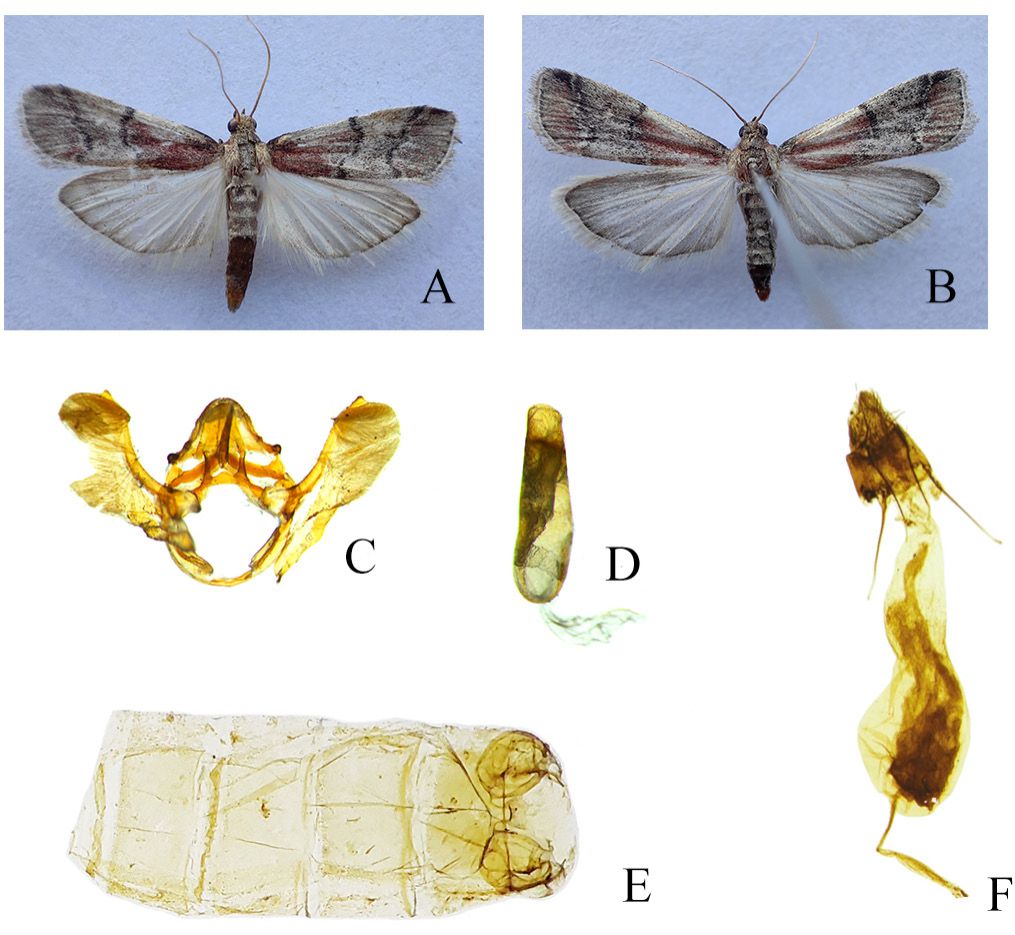
Figure 1. Euzophera alpherakyella: A – adult male; B – adult female; C – male arm genitals; D – aedeagus; E – female abdomen with tympanal organ; F – female genitalia.
Discussion
Several studies conducted to date have reported the presence of 62 species of the Phycitinae subfamily in Uzbekistan (Ragonot 1887; Koçak and Kemal 2012; Liu and Li 2012; Alipanah 2019; Tsvetkov 2024). However, since most of these records were not based on samples collected within the region, verified data on the number of species and the faunistic composition of this lepidopteran group in Uzbekistan remain limited. Therefore, systematic faunistic studies are necessary to clarify the actual species diversity and faunistic composition of Phycitinae within Uzbekistan. The first record of E. alpherakyella from Uzbekistan, particularly from the southern regions of the Fergana Valley, indicates that the diversity of the family Pyralidae in Uzbekistan is greater than previously assumed and highlights the need for continued investigations.
References
- Alipanah H (2019) Ratasa alienalis (Eversmann, 1844) (Lep.: Pyralidae: Phycitinae), a genus and species new to Iran. Journal of Insect Biodiversity and Systematics 5(4): 263–267. https://doi.org/10.52547/jibs.5.4.263
- Anikin VV, Baryshnikova SV, Beljaev EA, Budashkin YuI, Van Nieukerken EI, Dubatolov VV, Efetov KA, Zolotuhin VV, Knyazev SA, Kovtunovich VN, Kozlov MV, Kononenko VS, Lovtsova JuA, Lukhtanov VA, Lvovsky AL, Matov AYu, Mironov VG, Nedoshivina SV, Ponomarenko MG, Sviridov SV, Tsvetkov SV, Ustjuzhanin PYa, Yakovlev RV, Zolotuhin VV (2019) Annotated catalogue of the Lepidoptera of Russia. KMK Scientific Press, Moscow, 1–580.
- Jashenko RV, Tsvetkov SV, Yakovlev RV (2025) New data on the distribution and biology of Euzophera alpherakyella Ragonot, 1887 (Lepidoptera: Pyralidae) in Central Asia. Entomological Review 105(2): 210–218.
- Kemal M, Koçak AÖ (2017) Annotated Checklist of the Pyraloidea of Turkey (Lepidoptera). Cesa News 137: 1–124.
- Koçak AÖ, Kemal M (2012) Preliminary list of the Lepidoptera of Turkey. Priamus Supplement 25: 1–160.
- Liu Y, Li HH (2012) Taxonomic review of the genus Euzophera Zeller, 1867 (Lepidoptera: Pyralidae: Phycitinae) from China. Zootaxa 3512: 1–36.
- Nuss M, et al. (2003–2023) Global Information System on Pyraloidea. http://www.pyraloidea.org
- Ragonot EL (1887) Diagnoses of North American Phycitidae and Galleriidae. Proceedings of the United States National Museum 9: 254–257.
- Rajaei H, et al. (2023) New faunistic records of Pyraloidea from Iran. SHILAP Revista de lepidopterología 51(203): 419–426.
- Roesler RU (1973) Phycitinae. Microlepidoptera Palaearctica 4: 1–752.
- Sinev SY, Korb SK (2022) New and little-known species of Pyraloidea (Lepidoptera) from Russia and adjacent territories. Entomological Review 102(6): 773–784.
- Solis MA (2007) Key to selected Pyraloidea (Lepidoptera) larvae intercepted at U.S. ports of entry: revision of Pyraloidea in "Keys to some frequently intercepted lepidopterous larvae" by Weisman 1986. Zootaxa 1392: 1–84.
- Tsvetkov SV (2024) New records of Pyraloidea (Lepidoptera) from Uzbekistan. Far Eastern Entomologist 480: 1–10.
- Tschorsnig HP (2017) A new host record for Germaria angustata (Zetterstedt, 1844) (Diptera: Tachinidae). Studia dipterologica 24(1): 123–125.
- Yepishin V, et al. (2020) New data on the fauna of Pyraloidea (Lepidoptera) from Kazakhstan. SHILAP Revista de lepidopterología 48(191): 443–448.
- Ziegler J (2014) Tachinidae (Diptera) as parasitoids of Lepidoptera in Central Asia. Entomological Review 94(7): 1006–1013.