HETEROGENEOUS SULFATION REACTIONS OF LOW MOLECULAR WEIGHT CHITOSAN
UDC 547.458.6:541.6.66

Аннотация
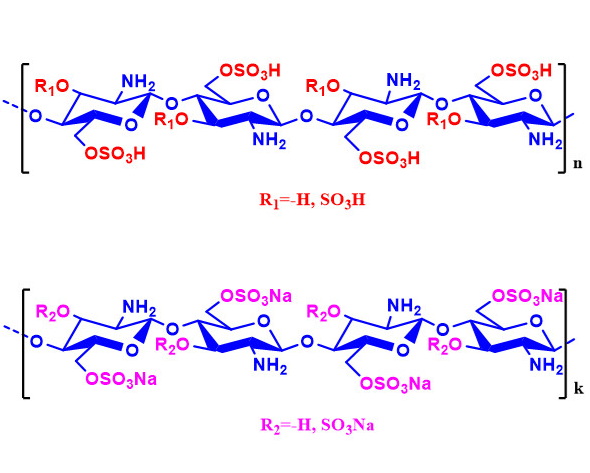
In this study, the heterogeneous sulfation of low molecular weight chitosan (LMWC, Mw = 12.2 kDa, DP = 73, PDI = 1.25) using sulfuric acid in isopropanol medium was systematically investigated. A series of sulfated chitosan derivatives were synthesized under varying reaction parameters, including temperature (-30 to +5 °C), time (1–24 h), and H₂SO₄ molar ratios (1.0–8.0 mmol/mmol GlcNU). The molecular characteristics of the obtained products varied within a wide range: DP = 58-73, DS = 0.026–1.289, sulfur content = 0.51–14.16%, SO3Na = 1.64–45.58%, with yields ranging from 10.12% to 80.12%. FTIR spectroscopy confirmed successful sulfation through characteristic -SO3- absorption bands at 1220, 1060, 987, and 814 cm-1, indicating that sulfation predominantly occurred at the C-6 position of glucosamine residues via hydroxyl and amino groups. The optimal reaction conditions were determined to be 4.0 mmol/mmol H2SO4 per glucosamine unit at -20 °C for 12 hours, ensuring high DS values and minimal depolymerization. Elemental analysis supported FTIR findings and showed high correlation between reaction variables and functional group incorporation. These results demonstrate that controlled heterogeneous sulfation of LMWC in isopropanol is an effective method to produce water-soluble, highly substituted chitosan derivatives with preserved backbone integrity. The obtained derivatives are promising for further biomedical applications such as drug delivery, anticoagulant formulations, and bioactive coatings. This study provides a clear understanding of how reaction parameters influence structural and functional outcomes in chitosan sulfation chemistry.
Скачивания
Литература
Tang W., Wang J., Hou H., Li Y., Wang J., Fu J., Lu L., Gao D., Liu Z., Zhao F., Gao X., Ling P., Wang F., Sun F., Tan H. International journal of biological macromolecules, 2023, vol. 240, 124398. https://doi.org/10.1016/j.ijbiomac.2023.124398.
El-Araby A., Janati W., Ullah R., Ercisli S., Errachidi F. Frontiers in Chemistry, 2024, vol. 11, 1327426. https://doi.org/10.3389/fchem.2023.1327426.
Pathak K., Misra S.K., Sehgal A., Singh S., Bungau S., Najda A., Gruszecki R., Behl T. Polymers, 2021, vol. 13, no. 15. 2514. https://doi.org/10.3390/polym13152514.
Hamedi H., Moradi S., Hudson S.M., Tonelli A.E., King M.W. Carbohydrate Polymers, 2022, vol. 282, 119100. https://doi.org/10.1016/j.carbpol.2022.119100.
Issahaku I., Tetteh I.K., Tetteh A.Y. Environmental Advances, 2023, vol. 11, 100351. https://doi.org/10.1016/j.envadv.2023.100351.
Jiménez-Gómez C.P., Cecilia J.A., Guidotti M.A. Molecules, 2020, vol. 25, no. 17, 3981. https://doi.org/10.3390/molecules25173981.
Román-Doval R., Torres-Arellanes S.P., Tenorio-Barajas A.Y., Gómez-Sánchez A., Valencia-Lazcano A.A. Polymers, 2023, vol. 15, no. 13, 2867. https://doi.org/10.3390/polym15132867.
Manna S., Seth A., Gupta P., Nandi G., Dutta R., Jana S., Jana S. ACS Biomaterials Science & Engineering, 2023, vol. 9, no. 5, pp. 2181–2202. https://doi.org/10.1021/acsbiomaterials.2c01297.
Wang Z., Yu F., Hu F. Pharmaceutics, 2024, vol. 16, no. 3, 337. https://doi.org/10.3390/pharmaceutics16030337.
Amonova D.M. i dr. Khimiya rastitel'nogo syr'ya, 2022, no. 2, pp. 51–60. https://doi.org/10.14258/jcprm.2022029551. (in Russ.).
Dimassi S., Tabary N., Chai F., Blanchemain N., Martelet B. Carbohydrate polymers, 2018, vol. 202, pp. 382–396. https://doi.org/10.1016/j.carbpol.2018.09.011.
Kocabay S., Bahar M. R., Tekin S., Akkaya R., Akkaya B. Polymers and Polymer Composites, 2021, vol. 29, no. 9, pp. S1023–S1032. https://doi.org/10.1177/09673911211035.
Yu Y., Dai K., Gao Z., Tang W., Shen T., Yuan Y., Wang J., Liu C. Science advances, 2021, vol. 7, no. 7, eabd8217. https://doi.org/10.1126/sciadv.abd821.
Shu Y., Yu Y., Zhang S., Wang J., Xiao Y., Liu C. Biomaterials science, 2018, vol. 6, no. 9, pp. 2496–2507. https://doi.org/10.1039/C8BM00701B.
Yang J., Luo K., Li D., Yu S., Cai J., Chen L., Du Y. International Journal of Biological Macromolecules, 2013, vol. 52, pp. 25–31. https://doi.org/10.1016/j.ijbiomac.2012.09.027.
Revuelta J., Fraile I., Monterrey D.T, Peña N., Benito-Arenas R., Bastida A., Fernández-Mayoralas A., García-Junceda E. Materials Horizons, 2021, vol. 8, no. 10, pp. 2596–2614. https://doi.org/10.1039/D1MH00728A.
Zou Y., Khor E. Carbohydrate polymers, 2009, vol. 77, no. 3, pp. 516–525. https://doi.org/10.1016/j.carbpol.2009.01.031.
Hong F., Qiu P., Wang Y., Ren P., Liu J., Zhao J., Gou D. Food Chemistry: X, 2024, vol. 21, 101095. https://doi.org/10.1016/j.fochx.2023.101095.
Muhitdinov B., Heinze T., Turaev A., Koschella A., Normakhamatov N. European Polymer Journal, 2019, vol. 119, pp. 181–188. https://doi.org/10.1016/j.eurpolymj.2019.07.030.
Žigrayová D., Mikušová V., Mikuš P. Gels, 2024, vol. 10, no. 11, 701. https://doi.org/10.3390/gels10110701.
Berezhnaya Y.D., Kazachenko A.S., Kazachenko A.S., Malyar Y.N., Borovkova V.S. Chemistry, 2024, vol. 6, no. 4, pp. 640–665. https://doi.org/10.3390/chemistry6040038.
Kyrgyzbayev Kh.G., Mukhitdinov B.I., Amonova D.M., Boydedayev A.A., Turayev A.S., Normakhamatov N.S. Farmatsevtika jurnali, 2021, no. 2, pp. 124–130. (in Uzb.).
El-Araby A., El Ghadraoui L., Errachidi F. Molecules, 2022, vol. 27, no. 23, 8285. https://doi.org/10.3390/molecules27238285.
Queiroz M.F., Teodosio Melo K.R,. Sabry D.A., Sassaki G.L., Rocha H.A.O. et al. Marine drugs, 2014, vol. 13, no. 1, pp. 141–158. https://doi.org/10.3390/md13010141.
Magallanes-Vallejo A.G., López-Oyama A.B., González E.R., Del Angel-López D., Pulido-Barragán E.U., García-Guendulain C., García-Guendulain T.J., Rodríguez-Beas C., Gámez-Corrales R. Polymers, 2025, vol. 17, no. 7, 889. https://doi.org/10.3390/polym17070889.
Riahi A., Mabudi H., Tajbakhsh E., Roomiani L., Momtaz H. AMB Express, 2024, vol. 14, no. 1, 77. https://doi.org/10.1186/s13568-024-01732-1.
Zhang X., Sun J. International Journal of Polymer Science, 2020, vol. 2020, no. 1, 9876408. https://doi.org/10.1155/2020/9876408.
Tesvichian S., Papassara S.,∙Srimongkol P.,∙Saisavoey T., Buakeaw A., ∙Puthong S., Thitiprasert S., Mekboonsonglarp W., Liangsakul J., Sopon A., Prawatborisut M., Reamtong O., Karnchanatat A. Heliyon, 2024, vol. 10, no. 2. https://doi.org/10.1016/j.heliyon.2024.e24444.
Copyright (c) 2026 Химия растительного сырья

Это произведение доступно по лицензии Creative Commons «Attribution» («Атрибуция») 4.0 Всемирная.

This work is licensed under a Creative Commons Attribution 4.0 International License.
Авторы, которые публикуются в данном журнале, соглашаются со следующими условиями:
1. Авторы сохраняют за собой авторские права на работу и передают журналу право первой публикации вместе с работой, одновременно лицензируя ее на условиях Creative Commons Attribution License, которая позволяет другим распространять данную работу с обязательным указанием авторства данной работы и ссылкой на оригинальную публикацию в этом журнале.
2. Авторы сохраняют право заключать отдельные, дополнительные контрактные соглашения на неэксклюзивное распространение версии работы, опубликованной этим журналом (например, разместить ее в университетском хранилище или опубликовать ее в книге), со ссылкой на оригинальную публикацию в этом журнале.
3. Авторам разрешается размещать их работу в сети Интернет (например, в университетском хранилище или на их персональном веб-сайте) до и во время процесса рассмотрения ее данным журналом, так как это может привести к продуктивному обсуждению, а также к большему количеству ссылок на данную опубликованную работу.