EXOGENOUS LIGNIN ENHANCES THE RESISTANCE OF LEMNA MINOR L. AQUATIC PLANTS TO COPPER STRESS
UDC 582.52:581.4; 574.24

Аннотация
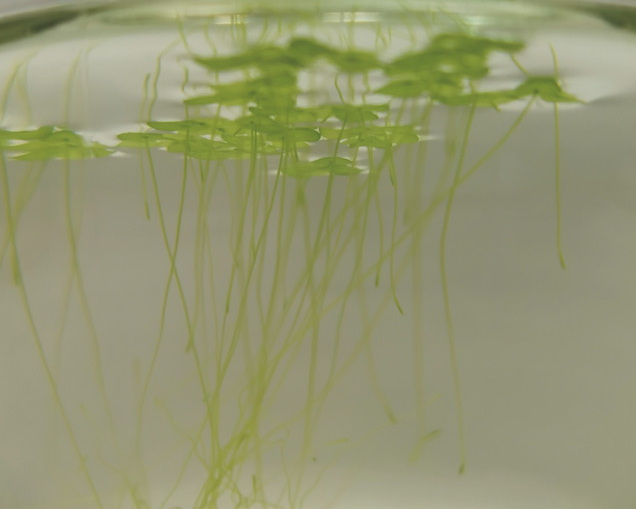
Currently, there is a growing interest in preparations made from lignin, due to their various useful properties. These include biodegradability, biocompatibility, harmlessness, and a wide range of biological activities. For the first time, the fundamental possibility of using exogenous lignin to protect aquatic plant organisms from the negative effects of copper ions has been demonstrated in this work. Lignin from ledum (Ledum palustre L.) was tested as a chemoprotective agent. Presents the results of a study on the biological activity of isolated lignin on a laboratory culture of duckweed (Lemna minor L.) under the influence of a copper stress factor. During the experiments, we established the values of biomarkers for plant well-being (growth rate, level of damage, frond area, content of malondialdehyde and chlorophyll) and found that water-soluble lignin from ledum was not toxic to plant organisms. Preliminary cultivation of plants in aqueous lignin-containing media increased the total frond area, had a positive effect on growth rate, and reduced the level of damage to duckweed in copper-containing aqueous media. It was concluded that pre-treating duckweed with water-soluble lignin would increase the plant's resistance to copper stress. The data obtained confirm the opinion about the adaptive and protective properties of lignin under the influence of stress factors of various nature.
Скачивания
Литература
Popa V. Lignin in biological Systems. In Polymeric biomaterials. CRC Press, 2020.
Dizhbite T., Telysheva G., Jurkjane V., Viesturs U. Bioresource Technology, 2004, vol. 95, no. 3, pp. 309–317. https://doi.org/10.1016/j.biortech.2004.02.024.
Bhardwaj R., Handa N., Sharma R., Kaur H., Kohli S., Kumar V., Kaur V. Physiological mechanisms and adaptation strategies in plants under changing environment, 2014, vol. 1, pp. 267–296. https://doi.org/10.1007/978-1-4614-8591-9_10.
Lu X., Gu X., Shi Y. International Journal of Biological Macromolecules, 2022, vol. 210, pp. 716–741. https://doi.org/10.1016/j.ijbiomac.2022.04.228.
Karmanov A., Kocheva L., Raskosha O., Moskalev A. Biocatalysis and Agricultural Biotechnology, 2023, vol. 53, ar-ticle 102848. https://doi.org/10.1016/j.bcab.2023.102969.
Weng J., Chapple C. New Phytologist, 2010, vol. 187, no. 2, pp. 273–285. https://doi.org/10.1111/j.1469-8137.2010.03327.x.
Zhang H., Asutosh A., Hu W. Sustainability, 2018, vol. 10, no. 12, article 4429. https://doi.org/10.3390/su10124429.
Gani A., Naruse I. Renewable Energy, 2007, vol. 32, no. 4, pp. 649–661. https://doi.org/10.1016/j.renene.2006.02.017.
Ekperusi O., Sikoki F.D., Nwachukwu E.O. Chemosphere, 2019, vol 223, pp. 285–309. https://doi.org/10.1016/j.chemosphere.2019.
Raskosha O., Karmanov A., Ermakova A., Bashlykova L., Pylina Ya., Starobor N., Bodnar I., Rasova E., Kocheva L. International Journal of Biological Macromolecules, 2024, vol. 283, 137609. https://doi.org/10.1016/j.ijbiomac.2024.137609.
Bodnar I., Raskosha O., Karmanov A., Kocheva L. Khimiya rastitel'nogo syr'ya, 2024, no. 2, pp. 99–108. https://doi.org/10.14258/jcprm.20240212979. (in Russ.).
Labeeuw L., Martone P.T., Boucher Y., Case R. Biology Direct, 2015, vol. 10, no. 1, pp. 1–21. https://doi.org/10.1186/s13062-015-0052-y.
Punia A. Environmental Science and Pollution Research, 2021, vol. 28, pp. 4056–4072. https://doi.org/10.1007/s11356-020-11580-8.
Mesquita A., Gonçalves F., Gonçalves A. International Journal of Environmental Research and Public Health, 2023, vol. 20, article 3706. https://doi.org/10.3390/ijerph20043706.
Zhao Z., Shi H., Duan D., Li H., Lei T., Wang M., Zhao Y. Aquatic Toxicology, 2015, vol. 164, pp. 92–98. https://doi.org/10.1016/j.aquatox.2015.04.019.
Pepper J., Baylis P., Adler E. Can. J. Chem., 1959, vol. 37, pp. 1241–1245. https://doi.org/10.1139/v59-183.
Patent 2277099 (RU). 2006. (in Russ.).
Karmanov A., Kanarsky A., Kocheva L., Belyy V., Semenov E., Rachkova N. Polymer, 2021, vol. 220, article 123571. https://doi.org/10.1016/j.polymer.2021.123571.
Steinberg R. Plant Physiol., 1946, vol. 21, pp. 42–48. https://doi.org/10.1104/pp.21.1.42.
Bodnar I., Cheban E., Zainullin V. Printsipy ekologii, 2018, vol. 2, pp. 4‒18. https://doi.org/10.15393/j1.art.2018.7402. (in Russ.).
Heath R., Packer L. Arch. Biochem. Biophys., 1968, vol. 125, pp. 189–198. https://doi.org/10.1016/0003-9861(68)90654-1.
Lichtenthaler H. Method Enzymol., 1987, vol. 148, pp. 350–382. https://doi.org/10.1016/0076-6879(87)48036-1.
Karmanov A., Kocheva L., Belyy V., Kanarsky A., Semenov E., Bogdanovich N., Pokryshkin S. Biocatalysis and Ag-ricultural Biotechnology, 2023, vol. 54, article 102969. https://doi.org/10.1016/j.bcab.2023.102969.
Wang Y., Wu J., Shen R., Li Y., Ma G., Qi S., Wu W., Jin Y., Jiang B. Journal of Bioresources and Bioproducts, 2023, vol. 8, no. 3, pp. 306–317. https://doi.org/10.1016/j.jobab.2023.05.001.
Takhtadzhyan A. Zhizn' rasteniy. [Plant life]. Moscow, 1982, vol. 6, pp. 493–500. (in Russ.).
Mir A., Pichtel J., Hayat S. BioMetals, 2021, vol. 34, no. 4, pp. 737–759. https://doi.org/10.1007/s10534-021-00306-z.
Yruela I. Funct. Plant Biol., 2009, vol. 36, no. 5, pp. 409–430. https://doi.org/10.1071/FP08288.
Artemkina N. Trudy Kol'skogo nauchnogo tsentra RAN. Seriya: Yestestvennyye i gumanitarnyye nauki, 2022, vol. 1, no. 2, pp. 120–128. https://doi.org/10.37614/2949-1185.2022.1.2.015.
Copyright (c) 2026 Химия растительного сырья

Это произведение доступно по лицензии Creative Commons «Attribution» («Атрибуция») 4.0 Всемирная.

This work is licensed under a Creative Commons Attribution 4.0 International License.
Авторы, которые публикуются в данном журнале, соглашаются со следующими условиями:
1. Авторы сохраняют за собой авторские права на работу и передают журналу право первой публикации вместе с работой, одновременно лицензируя ее на условиях Creative Commons Attribution License, которая позволяет другим распространять данную работу с обязательным указанием авторства данной работы и ссылкой на оригинальную публикацию в этом журнале.
2. Авторы сохраняют право заключать отдельные, дополнительные контрактные соглашения на неэксклюзивное распространение версии работы, опубликованной этим журналом (например, разместить ее в университетском хранилище или опубликовать ее в книге), со ссылкой на оригинальную публикацию в этом журнале.
3. Авторам разрешается размещать их работу в сети Интернет (например, в университетском хранилище или на их персональном веб-сайте) до и во время процесса рассмотрения ее данным журналом, так как это может привести к продуктивному обсуждению, а также к большему количеству ссылок на данную опубликованную работу.