EFFECT OF SULFATION ON STRUCTURAL, ELECTRONIC AND VIBRATIONAL PROPERTIES OF 4-O-5 LIGNIN DIMER: A DFT STUDY
UDC 547.992.3:544.18

Аннотация
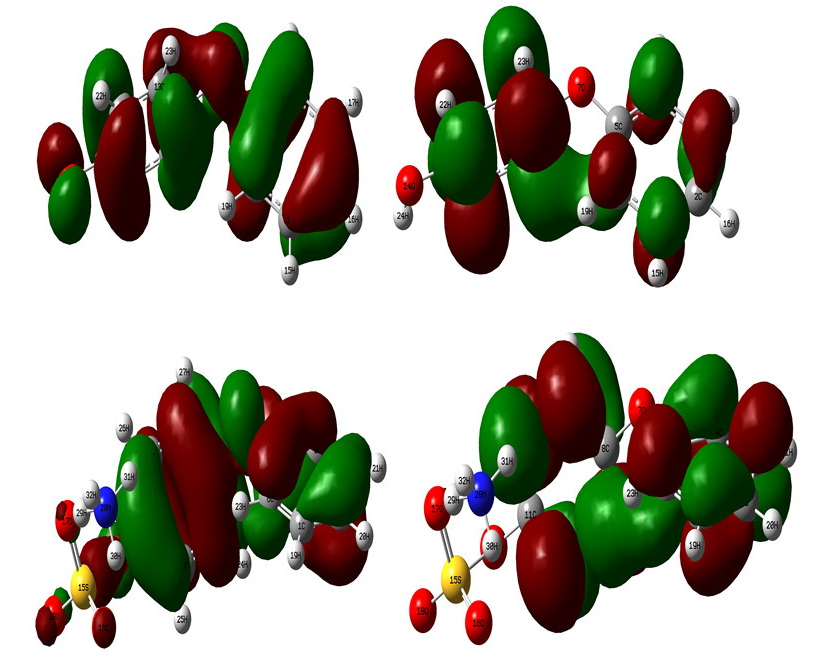
In the present work, a comparative study of the geometric, electronic and vibrational characteristics of the initial 4-O-5 lignin dimer and its sulfated form was performed using the density functional theory (DFT) method at the B3LYP/6-31G(d,p) level. The optimized molecular structures showed that the introduction of the sulfate group leads to significant changes in the C5-O7 and O7-C8 bond lengths, as well as in the bond angles associated with the ether bridge, indicating a redistribution of the electron density. Mulliken and APT charge analyses revealed an increased negative density on the oxygen atoms of the sulfate group and a positive charge on sulfur, indicating its strong electron-withdrawing character. An increase in the HOMO–LUMO energy gap from 5.408 eV to 5.570 eV after sulfation indicates an increase in the kinetic stability of the molecule. However, the growth in electronegativity (χ) and electrophilicity index (ω) indicate an increased tendency to electrophilic reactions. Molecular electrostatic potential (MEP) surfaces confirmed the increase in negative potential in the region of the sulfate group, which explains the improved hydrophilicity and solubility. Theoretical IR spectra show characteristic S-O bands at 1310, 1102, 861 and 655 cm-1, confirming the successful modeling of the sulfate derivative. The data obtained contribute to the understanding of the mechanisms of lignin modification and its behavior in biorefining processes and the synthesis of bioactive compounds.
Скачивания
Литература
Boerjan W., Ralph J., Baucher M. Annu. Rev. Plant Biol., 2003, vol. 54, pp. 519–546.
Vanholme R., Morreel K., Ralph J., Boerjan W. Curr. Opin. Plant Biol., 2008, vol. 11(3), pp. 278–285. https://doi.org/10.1016/j.pbi.2008.03.005.
Gosselink R.J.A. Lignin as a renewable aromatic resource for the chemical industry. Wageningen University, 2011, 191 p.
Nguyen L.T., Phan D.-P., Sarwar A., Tran M.H., Lee O.K., Lee E.Y. Ind. Crops Prod., 2021, vol. 161, 113219. https://doi.org/10.1016/j.indcrop.2020.113219.
Lora J.H., Glasser W.G. J. Polym. Environ., 2002, vol. 10(1-2), pp. 39–48.
Jeevanantham V., Jagatheesan R., Vinitha M., Snega P. Handbook of Lignin. Springer, Singapore, 2025, pp. 1–22. https://doi.org/10.1007/978-981-97-2664-6_27-1.
Kuznetsov B.N., Vasilyeva N.Y., Kazachenko A.S., Levdansky V.A., Kondrasenko A.A., Malyar Yu.N., Skvort-sova G.P., Lutoshkin M.A. Wood Sci. Technol., 2020, vol. 54, pp. 365–381. https://doi.org/10.1007/s00226-020-01157-6.
Nadányi R., Ház A., Lisý A., Jablonský M., Šurina I., Majová V., Baco A. Energies, 2022, vol. 15, 6520. https://doi.org/10.3390/en15186520.
Rahmani A., Abdulkhani A., Ashori A., Hosseinzadeh J. Sci. Rep., 2024, vol. 14, 28932. https://doi.org/10.1038/s41598-024-80256-x.
Kazachenko A.S., Akman F., Holikulov U., Jumabaev A., Malyar Yu.N. Mendeleev Commun., 2026, vol. 36, 260. https://doi.org/10.71267/mencom.7910.
Onley J.R., Gupta K., de Raad M., Bowen B.P., Tan S., Yoder S., Sale K.L., Singh A.K., Simmons B.A., Ad-ams P.D., Northen T.R., Deng K. Sci. Rep., 2025, vol. 15, 10296. https://doi.org/10.1038/s41598-025-88571-7.
Xiao L.-P., Lv Y.-H., Yang Y.-Q., Zou S.-L., Shi Z.-J., Sun R.-C. Int. J. Mol. Sci., 2023, vol. 24, 10304. https://doi.org/10.3390/ijms241210304.
Richel A., Vanderghem C., Simon M., Wathelet B., Paquot M. Anal. Chem. Insights, 2012, vol. 7, pp. 79–89. https://doi.org/10.4137/ACI.S10799.
Karmanov A.P., Ermakova A.V., Raskosha O.V., Bashlykova L.A., Rachkova N.G., Kocheva L.S. Khimiya Ras-titel'nogo Syr'ya, 2023, no. 4, pp. 5–28. https://doi.org/10.14258/jcprm.20230412560. (in Russ.).
Luo Z., Qian Q., Sun H., Wei Q., Zhou J., Wang K. Energies, 2023, vol. 16, 125. https://doi.org/10.3390/en16010125.
Becke A.D. J. Chem. Phys., 1993, vol. 98(7). https://doi.org/10.1063/1.464913.
Lee C., Yang W., Parr R.G. Phys. Rev. B, 1998, vol. 37(2). https://doi.org/10.1103/PhysRevB.37.785.
Frisch M.J., Trucks G.W., Schlegel H.B. et al. Gaussian 09, Revision D.1. Gaussian, Inc., Wallingford CT, 2009.
Dennington R., Keith T., Millam J. GaussView, Version 6. Semichem Inc., Shawnee Mission, KS, 2016.
Khudaykulov B., Norkulov A., Holikulov U., Absanov A., Doroshenko I., Jumabaev A. J. Low Temp. Phys., 2025, vol. 51(2). https://doi.org/10.1063/10.0035406.
Akman F., Kazachenko A.S., Malyar Y. Cellulose Chem. Technol., 2021, vol. 55(1-2), pp. 41–54. https://doi.org/10.35812/CelluloseChemTechnol.2021.55.05.
Becke A.D. J. Chem. Phys., 1993, vol. 98(7), pp. 5648–5652.
Jabha M., El Alaoui A., Jarid A., Houssine Mabrouk E. Optical Fiber and Applications. IntechOpen, 2023. http://dx.doi.org/10.5772/intechopen.109250.
Krivdin L.B. Molecules, 2021, vol. 26, 2450. https://doi.org/10.3390/molecules26092450.
Kazachenko A.S., Akman F., Vasilieva N.Y., Malyar Y.N., Fetisova O.Y., Lutoshkin M.A., Berezhnaya Y.D., Miroshnikova A.V., Issaoui N., Xiang Z. Polymers, 2022, vol. 14, 3000. https://doi.org/10.3390/polym14153000.
Makaveckas T., Šimonėlienė A., Šipailaitė-Ramoškienė V. Sustainability, 2025, vol. 17(21), 9913. https://doi.org/10.3390/su17219913.
Carbó-Dorca R., Bultinck P. J. Math. Chem., 2004, vol. 36, pp. 231–239. https://doi.org/10.1023/B:JOMC.0000044221.23647.20.
Masnabadi N., Thalji M.R., Alhasan H.S., Mahmoodi Z., Soldatov A.V., Ali G.A.M. Molecules, 2022, vol. 27, 4011. https://doi.org/10.3390/molecules27134011.
Jumabaev A., Khudaykulov B., Holikulov U., Norkulov A., Subbiah J., Al-Dossary O.M., Hushvaktov H., Absa-nov A., Issaoui N. Opt. Mater., 2025, vol. 159, 116683. https://doi.org/10.1016/j.optmat.2025.116683.
Chen D., Wang H. Proc. Combust. Inst., 2019, vol. 37(1), pp. 953–959. https://doi.org/10.1016/j.proci.2018.06.120.
Elshakre M.E., Noamaan M.A., Moustafa H., Butt H. Int. J. Mol. Sci., 2020, vol. 21, 1253. https://doi.org/10.3390/ijms21041253.
Sharma D., Tiwari S.N. J. Mol. Liq., 2016, vol. 214, pp. 128–135. https://doi.org/10.1016/j.molliq.2015.11.045.
Zheng Q., Nong G., Li N. Polymers, 2024, vol. 16, pp. 1237. https://doi.org/10.3390/polym16091237.
Copyright (c) 2026 Химия растительного сырья

Это произведение доступно по лицензии Creative Commons «Attribution» («Атрибуция») 4.0 Всемирная.

This work is licensed under a Creative Commons Attribution 4.0 International License.
Авторы, которые публикуются в данном журнале, соглашаются со следующими условиями:
1. Авторы сохраняют за собой авторские права на работу и передают журналу право первой публикации вместе с работой, одновременно лицензируя ее на условиях Creative Commons Attribution License, которая позволяет другим распространять данную работу с обязательным указанием авторства данной работы и ссылкой на оригинальную публикацию в этом журнале.
2. Авторы сохраняют право заключать отдельные, дополнительные контрактные соглашения на неэксклюзивное распространение версии работы, опубликованной этим журналом (например, разместить ее в университетском хранилище или опубликовать ее в книге), со ссылкой на оригинальную публикацию в этом журнале.
3. Авторам разрешается размещать их работу в сети Интернет (например, в университетском хранилище или на их персональном веб-сайте) до и во время процесса рассмотрения ее данным журналом, так как это может привести к продуктивному обсуждению, а также к большему количеству ссылок на данную опубликованную работу.