MODIFICATION OF FOOD POLYSACCHARIDE GUM ARABIC WITH POLYBASIC CARBOXYLIC ACIDS
UDC 54.057, 544.16

Аннотация
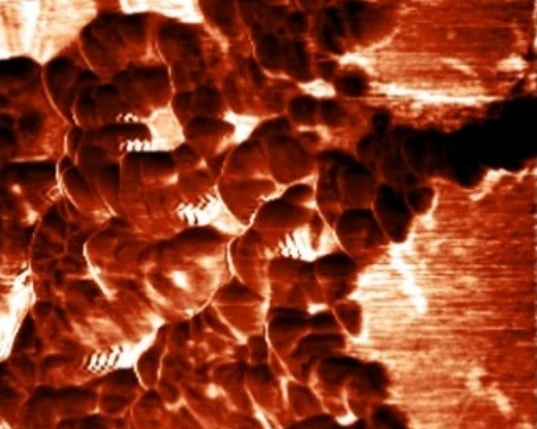
This work investigates the chemical modification of food-grade gum arabic (GA) using various polycarboxylic acids (citric, adipic, succinic, and oxalic) to enhance its functional properties for advanced applications. The esterification reaction was confirmed through a combination of elemental analysis and FTIR spectroscopy, which indicated the successful incorporation of carboxyl and ester groups into the polysaccharide structure. X-ray diffraction analysis revealed a further amorphization of the modified samples, confirming structural changes. Gel permeation chromatography showed a significant increase in the average molecular weight (Mw) and polydispersity of the derivatives, indicating both cross-linking and chain extension reactions. Atomic force microscopy demonstrated the formation of homogeneous, defect-free films consisting of spherical particles agglomerated into a continuous matrix. Thermal analysis (TGA/DSC) revealed modified thermal degradation patterns and showed that the oxalate derivative (GA-OxA) exhibited the highest thermal stability with a residual mass of 80.73% at 500 °C and the maximum activation energy for decomposition (295 kJ/mol). The results demonstrate the successful synthesis of tailored gum arabic derivatives with improved thermal properties and altered solubility, making them promising materials for applications in food packaging, edible coatings, and as carriers for controlled delivery systems.
Скачивания
Литература
Ashour M.A., Fatima W., Imran M., Ghoneim M.M., Alshehri S., Shakeel F. Molecules, 2022, vol. 27(4), 1171. https://doi.org/10.3390/molecules27041171.
Mohamed S.A., Elsherbini A.M., Alrefaey H.R., Adelrahman K., Moustafa A., Egodawaththa N.M., Crawford K.E., Nesnas N., Sabra S.A. Nanomaterials, 2025, vol. 15, 290. https://doi.org/10.3390/nano15040290.
Ward F.M. Cell and Developmental Biology of Arabinogalactan-Proteins. Springer, Boston, MA. 2000. https://doi.org/10.1007/978-1-4615-4207-0_20.
Mahendran T., Williams P.A., Phillips G.O., Al-Assaf S., Baldwin T.C. Journal of agricultural and food chemistry, 2008, vol. 56(19), pp. 9269–9276. https://doi.org/10.1021/jf800849a.
Churms S.C., Stephen A.M. Carbohydrate Research, 1970, vol. 15, no. 1, pp. 11–19. https://doi.org/10.1016/S0008-6215(00)80288-8.
Lee S.H., Md Tahir P., Lum W.C., Tan L.P., Bawon P., Park B.-D., Osman Al Edrus S.S., Abdullah U.H. Polymers, 2020, vol. 12, 1692. https://doi.org/10.3390/polym12081692.
Ragavan K.V., Hernandez-Hernandez O., Martinez M.M., Gutiérrez T.J. Trends in Food Science & Technology, 2022, vol. 119, pp. 45–56. https://doi.org/10.1016/j.tifs.2021.11.028.
Ermolenko I.N., Dovgalev S.I., Buglov E.D. et al. Pharm. Chem. J., 1973, vol. 7, pp. 105–108. https://doi.org/10.1007/BF00773538.
Fan L., Jiao W., Guo H. et al. J. Food Sci. Technol., 2025, vol. 62, pp. 1089–1100. https://doi.org/10.1007/s13197-024-06093-y.
Salihu R., Abd Razak S.I., Sani M.H., Wsoo M.A., Zawawi N.A., Shahir S. PloS one, 2024, vol. 19(12), e0312396. https://doi.org/10.1371/journal.pone.0312396.
Maiuolo L., Olivito F., Algieri V., Costanzo P., Jiritano A., Tallarida M.A., Tursi A., Sposato C., Feo A., De Nino A. Polymers, 2021, vol. 13, 2802. https://doi.org/10.3390/polym13162802.
Elnour A.A.M., Abdurahman N.H., Musa K.H., Rasheed Z. Int. J. Health Sci., 2023, vol. 17(6), pp. 4–5.
Malyar Y.N., Borovkova V.S., Kazachenko A.S., Fetisova O.Y., Skripnikov A.M., Sychev V.V., Taran O.P. Poly-mers, 2023, vol. 15(9), 1999. https://doi.org/10.3390/polym15091999.
Butt N.A., Ali T.M., Hasnain A. International journal of biological macromolecules, 2019, vol. 127, pp. 107–117. https://doi.org/10.1016/j.ijbiomac.2019.01.019.
Zehra N., Mohsin Ali T., Hasnain A. International journal of biological macromolecules, 2020, vol. 150, pp. 1331–1341. https://doi.org/10.1016/j.ijbiomac.2019.10.143.
Xie W., Shao L., Liu Y. J. Appl. Polym. Sci., 2010, vol. 116, pp. 218–224. https://doi.org/10.1002/app.31327.
Xu Y., Miladinov V., Hanna M.A. Cereal Chemistry, 2004, vol. 81, pp. 735–740. https://doi.org/10.1094/CCHEM.2004.81.6.735.
Luo Z., Zhou Z. Starch/Stärke, 2012, vol. 64, pp. 37–44. https://doi.org/10.1002/star.201100073
Kazachenko A.S. Vasilieva N.Y., Borovkova V.S. et al. Foods, 2021, vol. 10, no. 11, 2571.
Broido A. J. Polym. Sci., 1969, vol. 7 (Part A-2), 1761.
Copyright (c) 2025 Химия растительного сырья

Это произведение доступно по лицензии Creative Commons «Attribution» («Атрибуция») 4.0 Всемирная.

This work is licensed under a Creative Commons Attribution 4.0 International License.
Авторы, которые публикуются в данном журнале, соглашаются со следующими условиями:
1. Авторы сохраняют за собой авторские права на работу и передают журналу право первой публикации вместе с работой, одновременно лицензируя ее на условиях Creative Commons Attribution License, которая позволяет другим распространять данную работу с обязательным указанием авторства данной работы и ссылкой на оригинальную публикацию в этом журнале.
2. Авторы сохраняют право заключать отдельные, дополнительные контрактные соглашения на неэксклюзивное распространение версии работы, опубликованной этим журналом (например, разместить ее в университетском хранилище или опубликовать ее в книге), со ссылкой на оригинальную публикацию в этом журнале.
3. Авторам разрешается размещать их работу в сети Интернет (например, в университетском хранилище или на их персональном веб-сайте) до и во время процесса рассмотрения ее данным журналом, так как это может привести к продуктивному обсуждению, а также к большему количеству ссылок на данную опубликованную работу.