DIATOMITES AND LIGNINS AS MYCOTOXIN ADSORBENTS
UDC 547.458.82; 547.992.3:51.74

Abstract
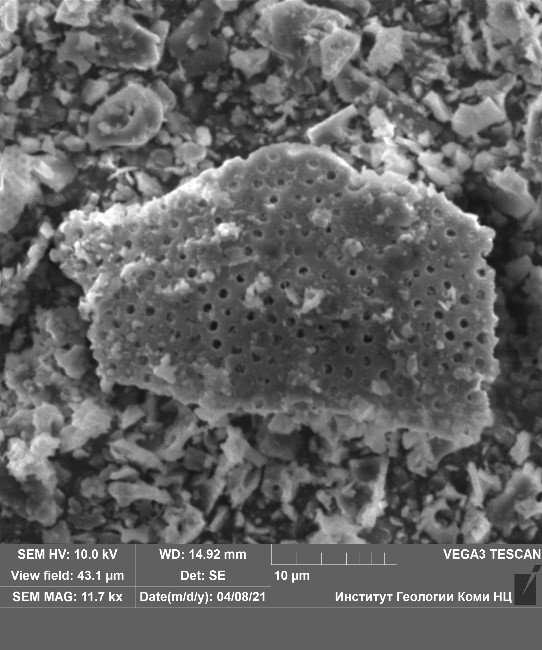
Currently, there is a tendency to deepen the mycotoxin problem, which is associated with the global warming and environmental pollution. The results of a study of the sorption capacity of adsorbents samples based on natural materials diatomites and lignins in relation to mycotoxin T-2 are presented. The chemical composition of diatomites of the Inzensk deposit before and after modification is given and the parameters of the surface-porous structure of the samples are established. The isotherms of adsorption and desorption of nitrogen on the surface of diatomites were studied and for the first time it was shown that they belong to the type IV(a) acording to IUPAC classification. The distribution of pores by size was studied and it was established that a significant proportion of the pore space of diatomites are mesopores with an average width of 7–12 nm. The highest adsorption rates of mycotoxin T-2 were established for a diatomite sample subjected to acid modification. Data on the adsorption of mycotoxin T-2 by samples of lignins isolated from the wood of birch Betula verrucosa, stems of rye Secale sp. and cabbage Brassica oleracea are given. The results of the determination of functional groups, elemental and monomeric composition of lignins are presented. It has been established that the adsorption capacity of drugs depends mainly on the peculiarities of the chemical structure of the studied samples. The highest adsorption rates of mycotoxin T-2 are established for lignin isolated from cabbage stems. Comparison of mycotoxin T-2 adsorption, surface porous structure parameters and chemical structure of various samples leads to the conclusion that for both diatomites and lignins, the chemisorption process plays the most important role.
Downloads
References
Boriskov D.Ye., Kuz'min A.A., Komarova N.A., Davydova M.A. Innovatsionnaya tekhnika i tekhnologiya, 2019, no. 3, pp. 68–74. (in Russ.).
Karmanov A.P., Kanarsky A.V., Kanarskaya Z.A., Kocheva L.S., Semenov E.I., Bogdanovich N.I., Belyy V.A. Inter-national Journal of Biological Macromolecules, 2020, vol. 144, pp. 111–117. DOI: 10.1016/j.ijbiomac.2019.12.081.
Richard J.L. International journal of food microbiology, 2007, vol. 119, no. 1–2, pp. 3–10. DOI: 10.1016/j.ijfoodmicro.2007.07.019.
Li Y., Wang Z., Beier R.C., Shen J., Smet D.D., De Saeger S., Zhang S. Journal of agricultural and food chemistry, 2011, vol. 59, no. 8, pp. 3441–3453. DOI: 10.1021/jf200767q.
Speijers G.J.A., Speijers M.H.M. Toxicology letters, 2004, vol. 153, pp. 91–98. DOI: 10.1016/j.toxlet.2004.04.046.
Zhang R., Xue H.L., Li L., Bi Y., Zong Y.Y., Carelle J.K. International Journal of Food Engineering, 2021, vol. 17, pp. 257–264. DOI: 10.1515/ijfe-2020-0095.
Ivanov S.E., Belyakov A.V. Glass and ceramics, 2008, vol. 65, pp. 18–21.
Bakr M. Asian Journal of Materials Science, 2010, vol. 2, no. 3, pp. 121–136.
Nguyen M.B., Nguyen T.V., Le G.H., Pham T.T., Le Van K., Pham G.T., Vu T.A. Journal of Chemistry, 2021, vol. 2021, 9762578. DOI: 10.1155/2021/9762578.
Shamsayei M., Yamini Y., Asiabi H. International Journal of Environmental Analytical Chemistry, 2020, pp. 1–17. DOI: 10.1080/03067319.2020.1743833.
Sun Z., Liu B., Li M., Li C., Zheng S. Journal of Materials Research and Technology, 2020, vol. 9, pp. 948–959. DOI: 10.1016/j.jmrt.2019.11.034.
Wang S., Su S., Xiao L.P., Wang B., Sun R.C., Song G. ACS Sustainable Chemistry & Engineering, 2020, vol. 8 (18), pp. 7031–7038. DOI: 10.1021/acssuschemeng.0c00462.
Grushko G.V., Linchenko S.N., Khan V.V. Uspekhi sovremennogo yestestvoznaniya, 2005, no. 8, pp. 74–78. (in Russ.).
Buszewska-Forajta M. Toxicon, 2020, vol. 182, pp. 34–53. DOI: 10.1016/j.toxicon.2020.04.101.
Chen F., Tobimatsu Y., Havkin-Frenkel D., Dixon R.A., Ralph J. Proceedings of the National Academy of Sciences, 2012, vol. 109, pp. 1772–1777. DOI: 10.1073/pnas.1120992109.
Pepper J.M., Baylis P.E., Adler E. Canad. J. Chem., 1959, vol. 37, no. 8, pp. 1241–1245.
Zakis G.F. Funktsional'nyy analiz ligninov i ikh proizvodnykh. [Functional analysis of lignins and their derivatives]. Riga, 1987, 230 p. (in Russ.).
Kalabin G.A., Kanitskaya L.V., Kushnarev D.F. Kolichestvennaya spektroskopiya YaMR prirodnogo organichesko-go syr'ya i produktov ikh pererabotki. [Quantitative NMR spectroscopy of natural organic raw materials and products of their processing]. Moscow, 2000, 408 p. (in Russ.).
Laboratornyye issledovaniya v veterinarii: biokhimicheskiye i mikologicheskiye [Laboratory research in veterinary med-icine: biochemical and mycological], ed. B.I. Antonov. Moscow, 1991, 287 p. (in Russ.).
Kryukov B.C., Krupin V.V., Kotik A.N. Veterinariya, 1992, no. 9–12, pp. 28–29. (in Russ.).
Thommes M., Kaneko K., Neimark A.V., Olivier J.P., Rodriguez-Reinoso F., Rouquerol J., Sing K.W. Pure and Ap-plied Chemistry, 2015, vol. 87, pp. 1051–1069. DOI: 10.1515/pac-2014-1117.
Copyright (c) 2022 chemistry of plant raw material

This work is licensed under a Creative Commons Attribution 4.0 International License.

This work is licensed under a Creative Commons Attribution 4.0 International License.
The authors, which are published in this journal, agree to the following conditions:
1. Authors retain the copyright to the work and transfer to the journal the right of the first publication along with the work, at the same time licensing it under the terms of the Creative Commons Attribution License, which allows others to distribute this work with the obligatory indication of the authorship of this work and a link to the original publication in this journal .
2. The authors retain the right to enter into separate, additional contractual agreements for the non-exclusive distribution of the version of the work published by this journal (for example, to place it in the university depository or to publish it in a book), with reference to the original publication in this journal.
3. Authors are allowed to post their work on the Internet (for example, in a university repository or on their personal website) before and during the review process of this journal, as this may lead to a productive discussion, as well as more links to this published work.