EVALUATION OF THE EFFECT OF SILICON OXIDE NANOPARTICLES OF DIFFERENT ORIGIN ON THE PRODUCTION OF SOME PRIMARY AND SECONDARY METABOLITES IN PLANTS OF THE FAMILIES FABACEAE, POACEAE
UDC 615.322:615.326:539.213.26

Abstract
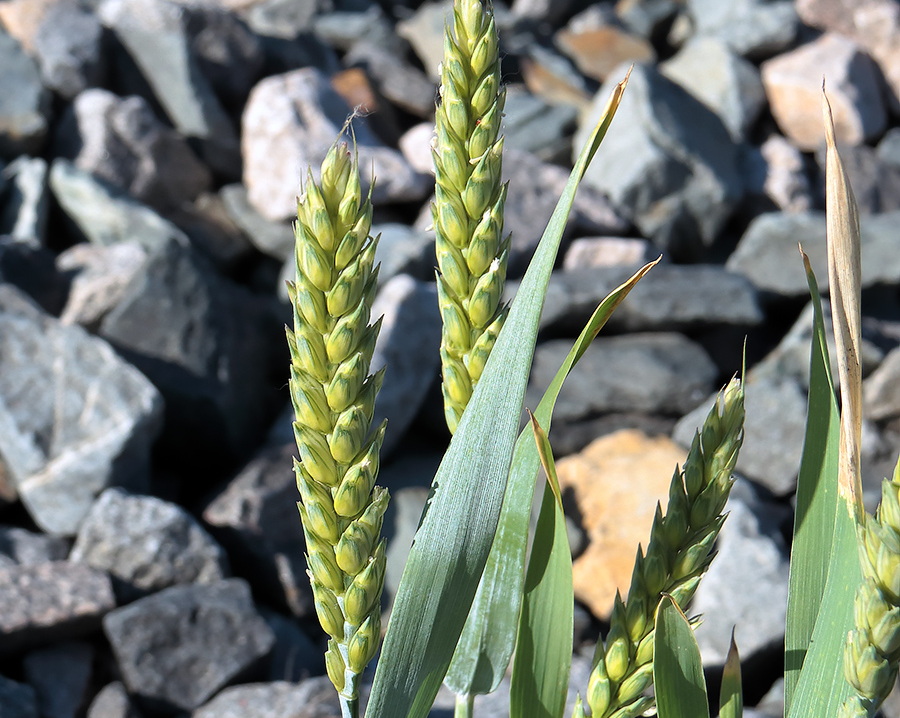
Scientists in different countries are conducting research on assessing a possibility of using silicon nanoparticles in various fields: medicine, pharmacy, medicinal crop production, etc. The work presents results of evaluating an influence of nanoparticles of different origin on production of primary and secondary metabolites. Nanoparticles, obtained from monomineral sand of natural origin, have been shown to increase production of primary and secondary metabolites in plants of the Poaceae family, as well as a content of a sum of chlorophylls, carotenoids, flavonoids, hydroxycinnamic acids, α- and β-chlorophylls and a majority of amino acids contained in leaves of Avena sativa (Poaceae) and Triticum aestivum (Poaceae).
Nanoparticles, obtained from synthetic quartz glass, influence production of only primary metabolites, an increase in a content of silicon and some amino acids in leaves and stems of Triticum aestivum (Poaceae).An effect of nanoparticles of different origin on a dynamics of accumulating sum of flavonoids and hydroxycinnamic acids by the example of the Fabaceae family has shown their increase in samples, collected at the beginning of a vegetation season. Morpho-structural analysis of nanoparticles of different origin has revealed differences in a morphology of particles, polymerization of silicon-oxygen chains, which probably explains the presence of distinctive features of a structure and peculiarities of their influence on production of metabolites in plants.
Downloads
References
Venzhik Y.V., Moshkov I.E., Dykman L.A. Russian Journal of Plant Physiology, 2021, vol. 68, no. 3, pp. 401–412. https://doi.org/10.1134/S1021443721020205.
Yurina T.A., Drobin G.V., Bogoslovskaya O.A., Olkhovskaya I.P., Glushchenko N.N. Sel'skokhozyaystvennaya biologiya, 2021, vol. 56, no. 1, pp. 135–145. https://doi.org/10.15389/agrobiology.2021.1.135rus. (in Russ.).
Panov D.A., Katsev A.M., Omel'chenko A.V. Khimiya Rastitel'nogo Syr'ya, 2022, no. 1, pp. 81–91. https://doi.org/10.14258/jcprm.2022019275. (in Russ.).
Akimov A.I., Solomonova E.S., Shoman N.Yu., Rylkova O.A. Russian Journal of Plant Physiology, 2023, vol. 70, no. 5, 111. https://doi.org/10.1134/s1021443723600253.
Kusum K., Neelam R., Vinita H. Plant Nano Biology, 2024, vol. 7, 100064. https://doi.org/10.1016/j.plana.2024.100064.
Rani N., Kumari K., Hooda V. Plant Physiology Reports, 2024, vol. 29, pp. 316–331. https://doi.org/10.1007/s40502-023-00774-0.
Voronkov M.G., Dyakov V.M. Silatrany. [Silatranes]. Novosibirsk, 1978, 207 p. (in Russ.).
Rao S.R., Ravishankar G.A. Biotechnology Advances, 2002, vol. 20 (2), pp. 101–153. https://doi.org/10.1016/s0734-9750(02)00007-1.
El-Kereti M.A., El-feky S.A., Khater M.S., Osman Y.A., Elsherbini E.A. Recent Patents on Food, Nutrition & Agri-culture, 2013, vol. 5 (3), pp. 169–181. https://doi.org/10.2174/2212798405666131112142517.
Kopach O.V., Kuzovkova A.A., Azizbekyan S.G., Reshetnikov V.N. Trudy BGU, 2013, vol. 8 (2), pp. 20–23. (in Russ.).
Volodina L.A., Baider L.M., Rakhmetova A.A., Bogoslovskaya O.A., Olkhovskaya I.P., Glushchenko N.N. Modern Chemical Physics. Tuapse, 2013, pp. 344–345.
Zelenkov V.N. Potapov V.V. Nanoindustry, 2020, vol. 13, no. 1, pp. 22–33. https://doi.org/10.22184/1993-8578.2020.13.1.22.33.
Werner M.K. Journal of Plant Physiology, 2005, vol. 162(12), pp. 1380–1381. https://doi.org/10.1016/j.jplph.2005.06.002.
Azim M., Iqbal N., Kausar S., Javed M.T., Akram M.S., Sajid M.A. Environ. Sci. Pollut. Res., 2015, vol. 22, pp. 14367–14371. https://doi.org/10.1007/s11356-015-4983-8.
Kim Y.H., Han A.L., Kim D.H., Lee S.Y., Kim K.M., Wax M. BMC Plant Biology, 2014, vol. 14 (1). https://doi.org/10.1186/1471-2229-14–13.
Dettmann K.K., Araujo V.L., Martins S.K., Sanglard L.M., Reis J.V., Dettmann E. New Phytologist, 2012, vol. 196 (3), pp. 752–762. https://doi.org/10.1111/j.1469-8137.2012.04299.x.
Dettmann K.K., Araujo V.L., Martens S.K., Fernie A.R., Da Мatta F.M. Plant signaling & Behaviour, 2013, vol. 8 (1), e22523. https://doi.org/10.4161/psb.22523.
Liu P., Ying L., Wang S., Zhang M., Deng H., Zhang S. et al. Environmental and Experimental Botany, 2015, vol. 111, pр. 42–51. https://doi.org/10.1016/j.envexpbot.2014.10.006.
Lu T., Jiang M., Jiang Z., Hui D., Wang Z., Zhou Z. Composites. Pt B, 2013, vol. 51, pp. 28–34. https://doi.org/10.1016/j.composites.2013.02.031.
Ma J., Cai H., He K., Zhang W., Wang L. New Phytologist, 2015, vol. 206 (3), pp. 1063–1074. https://doi.org/10.1111/nph.13276.
Shplis O., Kolomiez N., Abramez N., Deibova E., Karachieva N. Prospects for the Development of Agricultural Sci-ences. AGROSCIENCE – 2021: Int. Sci. Pract. Conf. Cheboksary, 2021, pp. 3–5.
Snytnikov V.N., Snytnikov D.A., Dubov V.I. et al. Applied Mechanics and Technical Physics, 2007, vol. 48, no. 2, pp. 172–184.
Bardakhanov S.P., Korchagin A.I., Kuksanov N.K., Lavrukhin A.A., Salimov R.A., Fadeev S.N., Cherepkov V.V. Reports of the Academy of Sciences, 2006, vol. 409, no. 3, pp. 320–323.
Metodika gosudarstvennogo sortoispytaniya sel'skokhozyaystvennykh kul'tur. [Methodology of state varietal testing of agricultural crops]. Moscow, 2019, vol. 1, 329 p. (in Russ.).
Kolomiets N.E., Kalinkina G.I., Sapronova N.N. Farmatsiya, 2011, no. 6, pp. 22–24. (in Russ.).
Gosudarstvennaya farmakopeya Rossiyskoy federatsii. XIV izd. [State Pharmacopoeia of the Russian Federation. XIV ed.]. Moscow, 2018, vol. 4, pp. 6539–6548. (in Russ.).
Kolomiets N.E., Kalinkina G.I. Farmatsiya, 2007, no. 1, pp. 11–14. (in Russ.).
Sun D., Hussain H.I., Yi Z., Ruks J.E., Kong L., Cahill D.M. Chemosphere, 2016, vol. 152, pp. 81–91. https://doi.org/10.1016/j.chemosphere.2016.02.096.
Sun D., Hussein H. I., Yi Z., Siegele R., Cresswell R., Kong L., Cahill D.M. Plant Cell Reports, 2014, vol. 33, pp. 1389–1402. https://doi.org/10.1007/s00299-014-1624-5.
MacDonald S.A., Schardt C.R., Masiello D.J., Simmons J.H. Journal of Non-Crystalline Solids, 2000, vol. 275, pp. 72–82.
Dunken H., Doremus R.H. Journal of Non-Crystalline Solids, 1989, vol. 92 (1), pp. 61–72.
Demars C., Pagel M., Deloule E., Blanc P. American Mineralogist, 1996, vol. 81, pp. 891–901. https://doi.org/10.2138/am-1996-7-812.
Yarovoy P.N. Lazernaya diagnostika lyuminestsiruyushchikh veshchestv. [Laser diagnostics of luminescent substanc-es]. Irkutsk, 1996, 176 p. (in Russ.).
Kuznetsov G.V., Taraschan A.N. Lyuminestsentsiya mineralov granitnykh pegmatitov [Luminescence of minerals of granite pegmatites]. Kyiv, 1988, 178 p. (in Russ.).
Pagel M., Barbin V., Blan P., Ohnenstetter D. Cathodoluminescence in geosciences. Berlin, 2000, 514 р. https://doi.org/10.1007/978-3-662-04086-7.
Gorobets B.S., Rogozhin A.A. Spektry lyuminestsentsii mineralov: Spravochnik. [Luminescence spectra of minerals: Reference book]. Moscow, 2001, 312 p. (in Russ.).
Boroznovskaya N.N., Korneva A.P., Marfin A.E. Key Engineering Materials, 2016, vol. 683, pp. 168–173. https://doi.org/10.4028/www.scientific.net/KEM.683.168.
Chukin G.D. Khimiya poverkhnosti i stroyeniye dispersnogo kremnezoma. [Surface chemistry and structure of dispersed silica]. Moscow, 2008, 172 p. (in Russ.).
Copyright (c) 2026 Chemistry of plant raw material

This work is licensed under a Creative Commons Attribution 4.0 International License.

This work is licensed under a Creative Commons Attribution 4.0 International License.
The authors, which are published in this journal, agree to the following conditions:
1. Authors retain the copyright to the work and transfer to the journal the right of the first publication along with the work, at the same time licensing it under the terms of the Creative Commons Attribution License, which allows others to distribute this work with the obligatory indication of the authorship of this work and a link to the original publication in this journal .
2. The authors retain the right to enter into separate, additional contractual agreements for the non-exclusive distribution of the version of the work published by this journal (for example, to place it in the university depository or to publish it in a book), with reference to the original publication in this journal.
3. Authors are allowed to post their work on the Internet (for example, in a university repository or on their personal website) before and during the review process of this journal, as this may lead to a productive discussion, as well as more links to this published work.