THE COMPONENT COMPOSITION OF THE RHIZOMES OF THE CIRSIUM HELENIOIDES (L.) HILL
UDC 543.544:615.582.9

Abstract
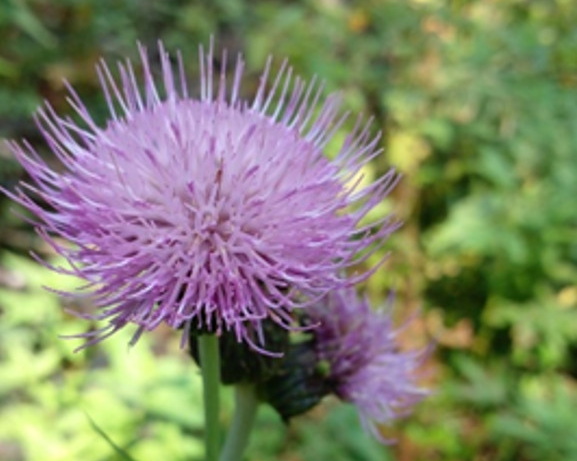
The biologically active substances of water-alcohol extraction from the rhizomes of wild elderberry (Cirsium helenioides (L.) Hill) were studied in the work. Samples of raw materials were harvested on the territory of the Kemerovo region ‒ Kuzbass. The study was carried out using a complex of chromatographic (low pressure column chromatography, HPLC, GC-MS, TLC) and spectral (electron spectroscopy, IR–FT) analysis methods. Low-pressure chromatography was performed using sephadex LH-20 modified with vancomycin as a sorbent. The use of this sorbent made it possible to carry out the preparative accumulation of key components, as well as minor components. Thus, the isomers p - coumaric acid and caffeic acid were isolated into separate fractions. Phytosterols campesterol and stigmasterol were isolated and preparatively accumulated for the first time. It has been established that water-alcohol extraction from the underground part of the plant contains simple phenylpropanoids: p-coumaric, caffeic, ferulic acids. The presence of monoterpene borneol is shown for the plant. The content of carbohydrate components was determined, which are represented by monosaccharides: glucopyranose, fructose, β-D-(+)-xylopyranose. The presence of the following polyatomic alcohols was noted: meso-erythritol, ribitol.
Downloads
References
Porras G., Chassagne F., Lyles J.T. et al. Chemical Reviews, 2021, vol. 121, no. 6, pp. 3495–3560. https://doi.org/10.1021/acs.chemrev.0c00922.
Luo W., Wu B., Tang L. et al. Journal of Ethnopharmacology, 2021, vol. 280, 114475. https://doi.org/10.1016/j.jep.2021.114475.
Marmouzi I., Bouyahya A., Ezzat S.M., Jemli M.E., Kharbac M. Journal of Ethnopharmacology, 2021, vol. 265, 113303. https://doi.org/10.1016/j.jep.2020.113303.
Zayed A., Serag A., Farag M.A. Journal of Functional Foods, 2020, vol. 69, 103937. https://doi.org/10.1016/j.jff.2020.103937.
Jin X., Liu S., Chen S., Wang L., Cui Y., He J., Fang S., Li J., Chang Y. Journal of Ethnopharmacology, 2023, vol. 308, 116223. https://doi.org/10.1016/j.jep.2023.116223.
Jeong G.H., Park E.K., Kima T.H. Phytochemistry Letters, 2018, vol. 26, pp. 115–119. https://doi.org/10.1016/j.phytol.2018.05.029.
Shin S., Saravanakumar K., Sathiyaseelan A. et al. Process Biochemistry, 2022, vol. 116, pp. 60–71. https://doi.org/10.1016/j.procbio.2022.02.017.
Lugmanova M.R., Fedorov N.I., Mikhaylenko O.I., Gurkova Ya.O. Rastitel'nyye resursy, 2011, vol. 47, no. 4, pp. 113–118. (in Russ.).
Aggarwal G., Kaur G., Bhardwaj G., Mutreja V., Sohal H.S., Nayik G.A., Bhardwaj A., Sharma A. Chemistry, 2022, vol. 4, pp. 1161–1192. https://doi.org/10.3390/chemistry4040079.
Tupitsyna N.N., Zvereva O.A. Vestnik KrasGAU, 2010, no. 11 (50), pp. 49–52. (in Russ.).
Volkova L.V., Lomonosova M.N. Turczaninowia, 2001, vol. 4, no. 1-2, pp. 73–78. (in Russ.).
Kupriyanov A.N., Kupriyanov O.A. Botanicheskiye issledovaniya Sibiri i Kazakhstana, 2019, no. 25, pp. 43–69. (in Russ.).
Christensen L.P. Phytochemistry, 1992, vol. 31, no. 6, pp. 2039–2041.
Kozyra M., Mardarowicz M., Kochmańska J. Natural Product Research, 2015, vol. 29, no. 20, pp. 1942–1944. https://doi.org/10.1080/14786419.2015.1010165.
Robbins R.J. J. Agric. Food Chem., 2003, vol. 51, pp. 2866–2887. https://doi.org/10.1021/jf026182.
Mil'man B.L., Zhurkovich I.K. Zhurnal analiticheskoy khimii, 2022, vol. 77, no. 5, pp. 412–426. https://doi.org/10.31857/S0044450222050085. (in Russ.).
Dagar R., Gautam A., Priscilla K., Sharma V., Gupta P., Kumar R. Plant Functional Genomics. Methods in Molecular Biology. Humana, New York, 2024, vol. 2788, pp. 19–37. https://doi.org/10.1007/978-1-0716-3782-1_2.
Temerdashev Z.A., Vinitskaya Ye.A., Korobkova V.V. Zhurnal analiticheskoy khimii, 2022, vol. 77, no. 11, pp. 1040–1051. https://doi.org/10.31857/S0044450222110123. (in Russ.).
Ghorbani M., Aghamohammadhassan M., Ghorbani H., Zabihi A. Microchemical Journal, 2020, vol. 158, 105250. https://doi.org/10.1016/j.microc.2020.105250.
Flint A.J., Davis A.P. Org. Biomol. Chem., 2022, vol. 20, pp. 7694–7712. https://doi.org/10.1039/d2ob01381a.
Tang Y., Hao J., Fan C., Cao X. Journal of Chromatography A, 2021, vol. 1636, 461772. https://doi.org/10.1016/j.chroma.2020.461772.
Chena L.-G., Wang C.-C. Separation and Purification Technology, 2009, vol. 66, pp. 65–70. https://doi.org/10.1016/j.seppur.2008.11.025.
Waksmundzka-Hajnos M., Sherma J., Kowalska T. Thin layer chromatography in phytochemistry. CRC Press Taylor & Francis Group, 2008, 896 р.
Copyright (c) 2026 Chemistry of plant raw material

This work is licensed under a Creative Commons Attribution 4.0 International License.

This work is licensed under a Creative Commons Attribution 4.0 International License.
The authors, which are published in this journal, agree to the following conditions:
1. Authors retain the copyright to the work and transfer to the journal the right of the first publication along with the work, at the same time licensing it under the terms of the Creative Commons Attribution License, which allows others to distribute this work with the obligatory indication of the authorship of this work and a link to the original publication in this journal .
2. The authors retain the right to enter into separate, additional contractual agreements for the non-exclusive distribution of the version of the work published by this journal (for example, to place it in the university depository or to publish it in a book), with reference to the original publication in this journal.
3. Authors are allowed to post their work on the Internet (for example, in a university repository or on their personal website) before and during the review process of this journal, as this may lead to a productive discussion, as well as more links to this published work.