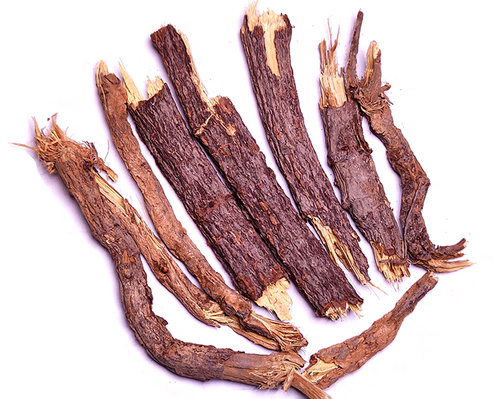
DELIVERY SYSTEM OF BIOLOGICALLY ACTIVE MOLECULES BASED ON DRY LICORICE ROOT EXTRACT GLYCYRRHIZA URALENSIS
УДК 577.1:577.352.34

Abstract
The composition of dry licorice root extract obtained from the manufacturer Wisterra by high performance liquid chromatography and gel penetrating chromatography was studied. Mechanochemically, the compositions with a number of poorly soluble biologically active substances - tebuconazole, fenbendazole, betulin, curcumin, melatonin, praziquantel, diosgenin, pinostrobin, albendazole, betulonic acid, vitamin D3 - were obtained and an increase in their solubility and transmembrane permeability was studied. In all cases, a significant up to ~103 -fold increase in these indicators was shown. In this case, the greatest increase in solubility is achieved for less soluble substances. The physico-chemical mechanism of increasing solubility is the incorporation of lipophilic molecules of biologically active substances into supramolecular structures. These structures are micelles and intermolecular complexes which formed by components of licorice extract. Named components are glycyrrhizic acid and poly- and oligosaccharides. An increase in the rate of transmembrane transfer, studied by the RAMPA assay method, has been shown, which should contribute to an increase in the bioavailability of low soluble biology active substances. Thus, the use of licorice extract as an auxiliary substance and mechanochemical technology in the production of nutrients products, including poorly soluble components, is justified in order to enhance their biological effect.
Downloads
References
Takagi T., Ramachandran Ch., Bermejo M., Yamashita Sh., Yu L.X., Amidon G.L. Molecular Pharmaceutics, 2006, vol. 3, no. 6, pp. 631–646. https://doi.org/10.1021/mp0600182.
Lokole P.B., Byamungu G.G., Mutwale P.K., Ngombe N.K., Mpuza M.K., Mudogo V., Krause R.W.M., Nkan-ga Ch.I. Next Nanotechnology, 2025, vol. 7, 100109. https://doi.org/10.1016/j.nxnano.2024.100109.
Prasher P., Sharma M., Mehta M., Satija S., Aljabali A.A., Tambuwala M.M., Anand K., Sharma N., Dureja H., Jha N.K., Gupta G., Gulati M., Singh S.K., Chellappan D.K., Paudel K.R., Hansbro Ph.M., Dua K. Colloid and Inter-face Science Communications, 2021, vol. 42, 100418. https://doi.org/10.1016/j.colcom.2021.100418.
Dushkin A.V., Meteleva E.S., Tolstikova T.G., Khvostov M.V., Polyakov N.E., Lyakhov N.Z. Chemistry for Sustain-able Development, 2019, vol. 27, no. 3, pp. 206–216. https://doi.org/10.15372/KhUR2019129.
Zhang Q., Xu W., Evseenko V.I., Meteleva E.S., Tolstikova T.G., Khvostov M.V., Polyakov N.E., Selyutina O.Yu., Dushkin A.V., Lyakhov N.Z., Su W. Chemistry for Sustainable Development, 2024, vol. 32, no. 5, pp. 718–740. https://doi.org/10.15372/KhUR2024605.
Dushkin A.V., Meteleva Ye.S., Tolstikova T.G., Khvostov M.V., Dolgikh M.P., Tolstikov G.A. Khimiya v interesakh ustoychivogo razvitiya, 2010, vol. 18, no. 4, pp. 517–525. (in Russ.).
Dushkin A.V., Tolstikova T.G., Khvostov M.V., Tolstikov G.A. The Complex World of Polysacchаraids, 2012, pp. 573–602.
Brovchenko B.V. Sovershenstvovaniye metodov kontrolya kachestva izmel'chennogo syr'ya i preparatov solodki: dis. … kand. farm. nauk. [Improving the methods of quality control of crushed raw materials and licorice preparations: diss. ... candidate of pharmaceutical sciences]. Moscow, 2020, 169 p. (in Russ.).
Shang Zh., Liu Ch, Qiao X., Ye M. Journal of Ethnopharmacology, 2022, vol. 299, 115686. https://doi.org/10.1016/j.jep.2022.115686.
Ain N.U., Wu Sh., Li X., Li D., Zhang Zh. Materials, 2022, vol. 15, 3654. https://doi.org/10.3390/ma15103654.
Wu Yu., Zhou H., Wei K., Zhang T., Che Ya., Nguyễn A. D., Pandita S., Wan X., Cui X., Zhou B., Li C., Hao P., Lei H., Wang L., Yang X., Liang Yi., Liu J., Wu Yi. Front. Immunol. Sec. Nutritional Immunology, 2022, vol. 13, 1007186. https://doi.org/10.3389/fimmu.2022.1007186.
Pan L-Ch., Zhu Yo-M., Zhu Zh-Yu., Xue W., Liu Ch-Yu, Sun H.-Q., Yin Yu. International Journal of Biological Macromolecules, 2020, vol. 155, pp. 560–571. https://doi.org/10.1016/j.ijbiomac.2020.03.192.
McCallum M.M. High-Throughput Approaches for the Assessment of Factors Influencing Bioavailability of Small Molecules in Pre-Clinical Drug Development: dis. … PhD. Wisconsin, 2013, 259 p.
Patent 2853270 (RU). 2025. (in Russ.).
Meteleva Ye.S., Yevseyenko V.I., Teplyakova O.I., Khalikov S.S., Polyakov N.E., Apanasenko I.Ye., Dushkin A.V., Vlasenko N.G. Khimiya v interesakh ustoychivogo razvitiya, 2018, no. 3, pp. 279–294. https://doi.org/10.15372/KhUR20180304. (in Russ.).
Arkhipov I.A., Varlamova A.I., Khalikov S.S., Sadov K.M., Dushkin A.V. Rossiyskiy parazitologicheskiy zhurnal, 2020, vol. 14, no. 1, pp. 70–74. https://doi.org/10.31016/1998-8435-2020-14-1-70-74. (in Russ.).
Patent 2794738 (RU). 2023. (in Russ.).
Patent 2816692 (RU). 2024. (in Russ.).
Dushkin A.V., Chistyachenko Yu.S., Komarov D.A., Khvostov M.V., Tolstikova T.G., Zhurko I.F., Kirilyuk I.A., Grigor'yev I.A., Lyakhov N.Z. Doklady akademii nauk, 2015, vol. 460, no. 1, pp. 107–110. (in Russ.).
Kansy M., Senner F., Gubernator K. J. Med. Chem., 1998, vol. 41, no. 7, pp. 1007–1010. https://doi.org/10.1021/jm970530e.
Copyright (c) 2026 Chemistry of plant raw material

This work is licensed under a Creative Commons Attribution 4.0 International License.

This work is licensed under a Creative Commons Attribution 4.0 International License.
The authors, which are published in this journal, agree to the following conditions:
1. Authors retain the copyright to the work and transfer to the journal the right of the first publication along with the work, at the same time licensing it under the terms of the Creative Commons Attribution License, which allows others to distribute this work with the obligatory indication of the authorship of this work and a link to the original publication in this journal .
2. The authors retain the right to enter into separate, additional contractual agreements for the non-exclusive distribution of the version of the work published by this journal (for example, to place it in the university depository or to publish it in a book), with reference to the original publication in this journal.
3. Authors are allowed to post their work on the Internet (for example, in a university repository or on their personal website) before and during the review process of this journal, as this may lead to a productive discussion, as well as more links to this published work.