FEATURES OF ACCUMULATION AND PROPERTIES OF AMORPHOUS SILICA IN PANICLES AND OTHER ORGANS OF RICE IN THE ONTOGENESIS OF VARIETIES OF FAR EASTERN BREEDING
UDC 633.18:546.284-31

Abstract
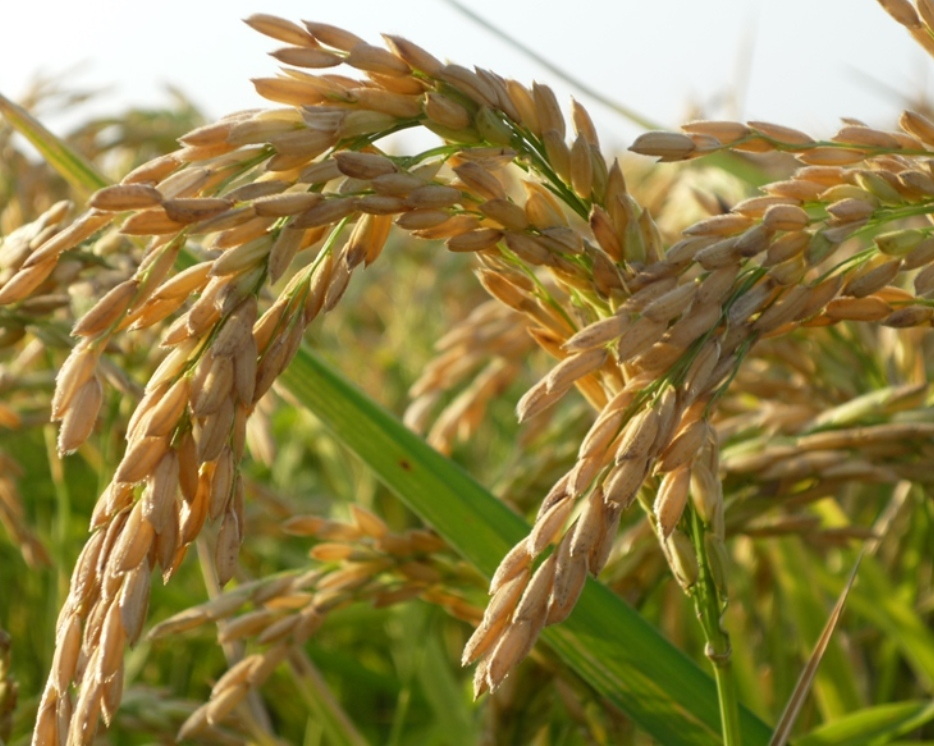
The features of accumulation, chemical composition and properties of silica in panicles and other organs of rice Oryza sativa of a number of varieties of Far Eastern breeding at different stages of ontogenesis are investigated. The physicochemical parameters of ash samples obtained from rice panicles are studied: chemical composition, acid-base properties, specific surface area values, their dependence on the rice variety is shown. In the aboveground parts of plants selected in the flowering phase, the ash yield depends on the plant variety, the highest values are observed for the ultra-ripe Cascade variety, which is characterized by a short, thick and strong stem. During the period of full maturation of rice panicles, the ash content of fruit scales (husks) increases by 1.5–2 times. The highest content of silicon dioxide in the ash of the aboveground shoot of rice plants is observed in samples of fruit scales, both in the flowering phase (92.7-97.8%) and in the full ripeness phase (98.7%). By the method of X-ray phase analysis, it was found that the ash residues of straw in the flowering phase are in an amorphous–crystalline state, and in the full ripeness phase - mainly in an amorphous state. The maximum proportion of extractive substances was noted in the samples obtained from the leaf blade, which is determined by the phase of plant development, the assimilation function of the leaves and the transport function of the stems.
Downloads
References
Voronkov M.G., Zel'chan G.I., Lukevits E.Ya. Kremniy i zhizn'. Biokhimiya, farmakologiya i toksikologiya soyed-ineniy kremniya. [Silicon and Life. Biochemistry, Pharmacology and Toxicology of Silicon Compounds]. Riga, 1978, 558 p. (in Russ.).
Carey J.C., Fulweiler R.W. PLOS One, 2012, vol. 7, no. 12, e52932. https://doi.org/10.1371/journal.pone.0052932.
Currie H.A., Perry C.C. Botanical briefing, 2007, vol. 100, pp. 1383–1389. https://doi.org/10.1093/aob/mcm247.
Avakyan E.R. Risovodstvo, 2004, no. 4, pp. 59–63. (in Russ.).
Zelenskiy G.L. Risovodstvo, 2009, no. 14, pp. 45–50. (in Russ.).
Kang J., Zhao W., Zhu X. Plant Physiology, 2016, vol. 199, pp. 76–86. https://doi.org/10.1016/j.jplph.2016.05.009.
Exley C. Frontiers in Plant Science, 2015, vol. 6, article 853. https://doi.org/10.3389/fpls.2015.00853.
Zelenskiy G.L., Avakyan E.R., Zelenskiy A.G. Risovodstvo, 2019, vol. 42, no. 1, pp. 43–46. (in Russ.).
Zelenskiy G.L. Politematicheskiy setevoy elektronnyy nauchnyy zhurnal Kubanskogo gosudarstvennogo agrarnogo universiteta, 2019, no. 147, pp. 160–173. https://doi.org/10.21515/1990-4665-147-019. (in Russ.).
Ma J.F., Yamaji N. Trends in Plant science, 2006, vol. 11, no. 8, pp. 392–397. https://doi.org/10.1016/j.tplants.2006.06.007.
Samsonova N.Ye. Agrokhimiya, 2019, no. 1, pp. 86–96. https://doi.org/10.1134/S0002188119010071. (in Russ.).
Ma J.F. Progress in Molecular and Subcellular Biology, 2003, vol. 33, pp. 127–147. https://doi.org/10.1007/978-3-642-55486-5_5.
Yoshida S., Onishi Y., Kitagishi K. Soil Science and Plant Nutrition, 1959, vol. 5, no. 1, pp. 23–27. https://doi.org/10.1080/00380768.1959.10430890.
Mitani N., Ma J.F. Journal of Experimental Botany, 2005, vol. 56, pp. 1255–1261. https://doi.org/10.1093/jxb/eri121.
Ma J.F., Yamaji N. Trends in Plant science, 2015, vol. 20, no. 7, pp. 435–442. https://doi.org/10.1016/j.tplants.2015.04.007.
Mingzhu P., Jun D., Xihua G., Xinyue L. Transactions of the Chinese Society of Agricultural Engineering, 2016, vol. 32, no. 4, pp. 309–314. https://doi.org/10.11975/j.issn.1002-6819.2016.04.044.
Lanning F.C., Ponnaiya B.W.X., Crumpton C.F. Plant Physiology, 1958, vol. 33, pp. 339–343. https://doi.org/10.1104/pp.33.5.339.
Zhang C., Wang L., Zhang W. Plant Soil, 2013, vol. 372, pp. 137–149. https://doi.org/10.1007/s11104-013-1723-z.
Mann S., Perry C.C. CIBA foundation symposium: silicon biochemistry. London: Wiley, 1986, vol. 121, pp. 40–58.
Zemnukhova L.A. Aref'yeva O.D., Kovekhova A.V., Polyakova N.V., Panasenko A.Ye., Kamayeva A.Yu. Izvestiya vuzov. Prikladnaya khimiya i biotekhnologiya, 2019, vol. 9, no. 2, pp. 159–169. https://doi.org/10.21285/2227-2925-2019-9-2-159-169. (in Russ.).
Lisichkin G.V., Serdan A.A., Kudryavtsev G.V., Staroverov S.M., Yuffa A.Ya. Modifitsirovannyye kremnezemy v sorbtsii, katalize i khromatografii. [Modified silicas in sorption, catalysis and chromatography]. Moscow, 1986, 248 p. (in Russ.).
Zemnukhova L.A., Nikolenko Yu.M. Zhurnal obshchey khimii, 2011, vol. 8, no. 4, pp. 602–608. (in Russ.).
Kolesnikov M.P. Uspekhi biologicheskiy khimii, 2001, vol. 41, pp. 301–332. (in Russ.).
Van Soest P.J. Animal Feed Science and Technology, 2006, vol. 130, pp. 137–171. https://doi.org/10.1016/j.anifeedsci.2006.01.023.
Zemnukhova L.A., Fedorishcheva G.A., Yegorov A.G., Sergiyenko V.I. Zhurnal prikladnoy khimii, 2005, vol. 78, no. 2, pp. 324–328. (in Russ.).
Zemnukhova L.A., Yegorov A.G., Fedorishcheva G.A., Barinov N.N., Sokol'nitskaya T.A., Botsul A.I. Neorganich-eskiye materially, 2006, vol. 42, no. 1, pp. 27–32. (in Russ.).
Zemnukhova L.A., Polyakova N.V., Fedorishcheva G.A., Tsoy Ye.A. Khimiya rastitel'nogo syr'ya, 2013, no. 1, pp. 209–214. https://doi.org/10.14258/jcprm.1301209. (in Russ.).
Zemnukhova L.A., Panasenko A.Ye., Tsoy Ye.A., Fedorishcheva G.A., Shapkin N.P., Artem'yanov A.P., Mayorov V.Yu. Neorganicheskiye materialy. 2014, vol. 50, no. 1, pp. 82–89. https://doi.org/10.7868/S0002337X14010205. (in Russ.).
Aref'yeva O.D., Pirogovskaya P.D., Panasenko A.Ye., Kovekhova A.V., Zemnukhova L.A. Khimiya rastitel'nogo syr'ya, 2021, no. 1, pp. 327–335. https://doi.org/10.14258/jcprm.2021017521. (in Russ.).
Ikonnikova K.V., Ikonnikova L.F., Minakova T.S., Sarkisov Yu.S. Teoriya i praktika pH-metricheskogo opredeleniya kislotno-osnovnykh svoystv poverkhnosti tverdykh tel: ucheb. posobiye dlya vuzov. [Theory and practice of pH-metric determination of acid-base properties of solid surfaces: textbook for universities]. Tomsk, 2011, 85 p. (in Russ.).
Minakova T.S. Adsorbtsionnyye protsessy na poverkhnosti tverdykh tel: ucheb. posobiye dlya vuzov. [Adsorption pro-cesses on the surface of solids: a textbook for universities]. Tomsk, 2007, 284 p. (in Russ.).
Kel'tsev N.V. Osnovy adsorbtsionnoy tekhniki. [Fundamentals of adsorption technology]. Moscow, 1984, 592 p. (in Russ.).
Sunitskaya T.V., Guchenko S.S., Burundukova O.L. Vestnik Krasnoyarskogo gosudarstvennogo agrarnogo universi-teta, 2019, vol. 151, no. 10, pp. 3–9. (in Russ.).
Kholupenko I.P., Burundukova O.L., Zhemchugova V.P., Voronkova N.M., Chernoded G.K. Fiziologiya rasteniy, 1996, vol. 43, no. 2, pp. 165–173. (in Russ.).
Plyusnina I.I. Infrakrasnyye spektry mineralov. [Infrared spectra of minerals]. Moscow, 1976, 175 p. (in Russ.).
Arefieva O.D., Zemnukhova L.A., Gorlova V.A., Tsvetnov M.A. Water Practice & Technology, 2021, vol. 16, no. 2, pp. 351–363. https://doi.org/10.2166/wpt.2020.117.
Copyright (c) 2025 chemistry of plant raw material

This work is licensed under a Creative Commons Attribution 4.0 International License.

This work is licensed under a Creative Commons Attribution 4.0 International License.
The authors, which are published in this journal, agree to the following conditions:
1. Authors retain the copyright to the work and transfer to the journal the right of the first publication along with the work, at the same time licensing it under the terms of the Creative Commons Attribution License, which allows others to distribute this work with the obligatory indication of the authorship of this work and a link to the original publication in this journal .
2. The authors retain the right to enter into separate, additional contractual agreements for the non-exclusive distribution of the version of the work published by this journal (for example, to place it in the university depository or to publish it in a book), with reference to the original publication in this journal.
3. Authors are allowed to post their work on the Internet (for example, in a university repository or on their personal website) before and during the review process of this journal, as this may lead to a productive discussion, as well as more links to this published work.