THERMAL PARAMETERS OF TORREFACTS AND BIOCHAR OBTAINED FROM THE POST-EXTRACTION RESIDUE OF SPRUCE NEEDLES
UDC 544-971+674.02

Abstract
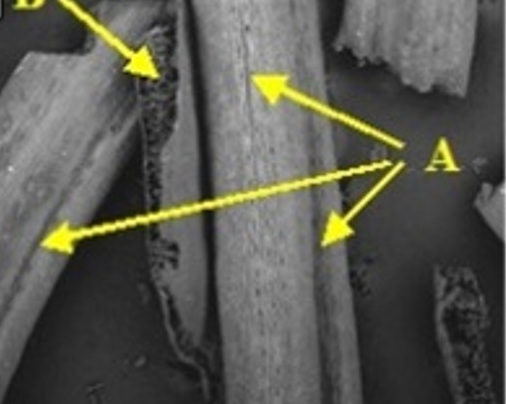
Torrefacts and biochar were first obtained as a result of pyrolysis at 250, 350, 450, 550, 650 °C of the natural spruce needles (Picea obovata Ledeb.) post-extraction by water-amino alcohol solid residue. They were studied using scanning electron microscopy (SEM), thermogravimetry (TG/DTG) and differential scanning calorimetry (DSC). The change of the needles natural tissues during the biochar formation was established by SEM. According to the energy-dispersive X-ray spectra of the elemental composition of mineral inclusions randomly distributed on the surface and internal structures of biochar 8 elements were found – Al, Si, Cl, K, Ca, Fe, P, Br. By deconvolution of the DTG and DSC contours, the process of oxidative thermal degradation of torrefacts and biochar is visualized in detail. For each pyrolysis product, the main kinetic parameters of thermal decomposition in an oxidizing medium are calculated: the activation energy (varies between 53.3–195.3 kJ/mol) and the rate constant of thermal degradation reactions (varies from 0.17 to 0.24 min-1). The dependence of the yield of torrefacts and biochar on the pyrolysis temperature of PERN is approximated by a polynomial of the 3rd degree, R2 = 0.999. The calorific value of biochar (according to DSC data) varies from 23.15 to 25.41 MJ/kg. The thermal stability of torrefacts and biochar is symbate with the pyrolysis temperature of PERN and increases from 370 to 476 °C when they are heated at a rate of 20 °C/min to 900 °C. The results of the study can be used to develop optimal compositions {sawdust}-{torreficate (biochar)} in the production of fuel materials with
Downloads
References
Butnaru E., Brebu M. Rev. Chim., 2022, vol. 73, no. 3, pp. 28–37. https://doi.org/10.37358/rc.22.3.8532.
Sokolov V.A., Farber S.K., Shchepashchenko D.G. i dr. Otsenka lesov Sibiri v usloviyakh global'nykh izmeneniy. [As-sessment of Siberian forests in the context of global changes]. St. Petersburg, 2023, 326 p. (in Russ.).
Mednikov F.A. Izvestiya vuzov. Lesnoy zhurnal, 1976, no. 3, pp. 116–118. (in Russ.).
Gvozdev V.K., Volkovich A.P. Trudy BGTU. Seriya 1, 2021, no. 2, pp. 66–72. (in Russ.).
GOST 21769-84. Gosudarstvennyy standart. Zelen' drevesnaya. Tekhnicheskiye usloviya. [GOST 21769-84. State standard. Wood greenery. Specifications]. Moscow, 1984, 7 p. (in Russ.).
Yagodin V.I. Osnovy khimii i tekhnologii pererabotki drevesnoy zeleni [Fundamentals of chemistry and technology of processing wood greenery], ed. Yu.I. Khol'kin. Leningrad, 1981, 224 p. (in Russ.).
Levin E.D., Repyakh S.M. Pererabotka drevesnoy zeleni. [Processing of wood greenery]. Moscow, 1984, 120 p. (in Russ.).
Singh P., Singh T.P., Sharma R.K., Negi Y.K., Ramesh Pal. Journal of Agricultural Engineering, 2021, vol. 58, no. 2, pp. 192–203.
Loskutov S.R., Kazaryan L.K., Petrunina Ye.A., Aniskina A.A. Khimiya v interesakh ustoychivogo razvitiya, 2023, no. 31, pp. 49–59. https://doi.org/10.15372/KhUR2023438. (in Russ.).
Uendlandt U., Stepanov V.A., Bernshteyn V.A. Termicheskiye metody analiza. [Thermal methods of analysis]. Mos-cow, 1978, 528 p. (in Russ.).
Broido A. Journal of polymer science, 1969, vol. 7, pp. 1761–1773.
Ming G., Qiu-ju D. The Chinese Journal of Process Engineering, 2006, vol. 6, no. 2, pp. 242–246.
Baroni É.G., Tannous K., Rueda-Ordóñez Y.J., Tinoco-Navarro L.K. J. Therm. Anal. Calorim., 2016, vol. 123, pp. 909–917.
Loskutov S.R., Permyakova G.V., Aniskina A.A., Peryshkina G.I. Rastitel'nyye resursy, 1997, vol. 33, no. 2, pp. 74–78. (in Russ.).
Loskutov S.R., Shapchenkova O.A., Petrunina E.A., Plyashechnik M.A., Tyut’kova E.A., Pashenova N.V., Grodnit-skaya I.D., Aniskina A.A., Senashova V.A. Russian Journal of Bioorganic Chemistry, 2023, vol. 49, no. 7, pp. 1614–1623. https://doi.org/10.1134/s1068162023070762.
Savitzky A., Golay M.J.E. Analytical Chemistry, 1964, vol. 36, no. 8, pp. 1627–1639.
Luo J., Ying K., He P., Bai J. Digital Signal Processing, 2005, vol. 15, pp. 22–136.
Kazaryan L.K., Loskutov S.R., Shapchenkova O.A., Plyashechnik M.A., Shimova Yu.S. Lesnoy vestnik, 2023, vol. 27, no. 6, pp. 84–97. https://doi.org/10.18698/2542-1468-2023-6-84-97. (in Russ.).
Guida M.Y., Lanaya S., Rbihi Z., Hannioui A. Environ. Sci., 2019, vol. 10 (8), pp. 742–755.
Yarusova S.B., Makarenko N.V., Gordiyenko P.S., Karpenko M.A., Novikova Ye.S. Zhurnal fizicheskoy khimii, 2018, vol. 92, no. 3, pp. 451–456. https://doi.org/10.7868/S0044453718030354. (in Russ.).
Vodolazov L.I., Sharapov B.N., Sharapova N.A., Laskorin B.N. DAN SSSR, 1989, vol. 307, no. 1, pp. 139–143. (in Russ.).
Copyright (c) 2026 Chemistry of plant raw material

This work is licensed under a Creative Commons Attribution 4.0 International License.

This work is licensed under a Creative Commons Attribution 4.0 International License.
The authors, which are published in this journal, agree to the following conditions:
1. Authors retain the copyright to the work and transfer to the journal the right of the first publication along with the work, at the same time licensing it under the terms of the Creative Commons Attribution License, which allows others to distribute this work with the obligatory indication of the authorship of this work and a link to the original publication in this journal .
2. The authors retain the right to enter into separate, additional contractual agreements for the non-exclusive distribution of the version of the work published by this journal (for example, to place it in the university depository or to publish it in a book), with reference to the original publication in this journal.
3. Authors are allowed to post their work on the Internet (for example, in a university repository or on their personal website) before and during the review process of this journal, as this may lead to a productive discussion, as well as more links to this published work.