TRITERPENE GLYCOSIDE FROM THE PLANT CORTUSA MATTHIOLI L.
UDC 547.918:547.022

Abstract
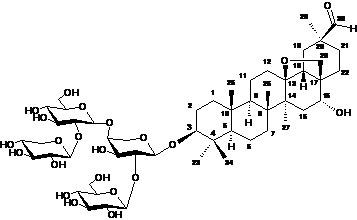
Some representatives of the Primulaceae family consider to a promising sources of saponins. It is established that some species of this family contain significant concentrations of triterpene glycosides having interesting biological. According to the literature, in plants Cortusa turkestanica Losinsk. both steroid and triterpene glycosides were found, the content of which is 7.3%, and the hemolytic index reaches 25.000. The only representative of the genus Cortusa in the flora of the Komi Republic is Cortusa matthioli L. It is a boreal Eurasian species that grows almost everywhere in the forest zone of the Republic. From the aboveground part of the plant C. mattioli, collected in the vicinity of Syktyvkar in the flowering phase, by we for the first time were isolated triterpene glycoside pentacyclic series with gross formula C52H84O22. Using spectral methods (IR, NMR spectroscopy and high resolution mass spectrometry), the compound was identified as β-D-xylopyranosyl-(1→2)-β-D-glucopyranosyl-(1→4)-[β-D-glucopyranosyl-(1→2)]-α-L-arabinopyranosyl-(1→3)-13β, 28-epoxyolean-30-al-3β, 16α-diol. Previously this compound, for which cytotoxic activity against human colon cancer cells, uterine sarcoma and human melanoma was detected, was found in plants of Ardisia crispa, Myrsine pellucida, Androsace saxifragifolia, as well as some species of the genus Cyclamen.
Downloads
References
Kintya P.K., Lazur'yevskiy G.V., Balashova N.N., Balashova I.T., Suruzhiu A.I., Lyakh V.A. Stroyeniye i biolog-icheskaya aktivnost' steroidnykh glikozidov ryada spirostana i furostana. [The structure and biological activity of ster-oid glycosides of a number of spirostan and furostan]. Kishinev, 1987, 142 p. (in Russ.).
Vasil'yeva I.S., Paseshnichenko V.A. Prikladnaya biokhimiya i mikrobiologiya, 1999, vol. 35, no. 5, pp. 521–535. (in Russ.).
Rastitel'nyye resursy SSSR: Tsvetkovyye rasteniya, ikh khimicheskiy sostav, ispol'zovaniye; Semeystva Paeoniaceae – Thymelaeaceae. [Plant resources of the USSR: Flowering plants, their chemical composition, use; Families Paeoniaceae – Thymelaeaceae]. Leningrad, 1986, vol. 2, 336 p. (in Russ.).
Asilbekova D.T., Nuriddinov KH.R. Khimiya rastitel'nogo syr'ya, 2011, no. 4, pp. 219–222. (in Russ.).
Flora severo-vostoka yevropeyskoy chasti SSSR. Semeystva Umbelliferae – Compositae. [Flora of the north-east of the European part of the USSR. Families Umbelliferae – Compositae]. Leningrad, 1977, vol. 4, 312 p. (in Russ.).
Beshley I.V., Ufimtsev K.G., Volodin V.V., Shirshova T.I. Rastitel'nyye resursy, 2018, vol. 54, no. 4, pp. 532–541, DOI: 10.1134/S0033994618040040. (in Russ.).
Tsedilin A.M., Fakhrutdinov A.N., Eremin D.V., Zalesskiy S.S., Kolotyrkina N.G., Ananikov V.P. Med. Comm., 2015, vol. 25, no. 11, pp. 454–456, DOI: 10.1016/j.mencom.2015.11.019.
Waltho J.P., Williams D.H., Mahato S.B., Pal B.C., Barna J.C.J. J. Chem. Soc. Perkin Trans., 1986, vol. 8, no. 1, pp. 1527–1531, DOI: 10.1039/P1986000152.
Ding Z., He Y., Ding J. Acta Bot. Yunnanica, 1993, vol. 15, no. 2, pp. 201–204.
Zhang X., Peng S., Wang M., Ding L. Acta. Pharm. Sinica, 1999, vol. 34, no. 11, pp. 838–840.
Liang B., Zhang L., Tian J., Xu L., Yang S. Carbohydrate Research, 2006, vol. 341, no. 14, pp. 2444–2448, DOI: 10.1016/j.carres.2006.06.020.
Altunkeyik H., Gülcemal D., Masullo M., Alankus-Caliskan O., Piacente S., Karayildirim T. Phytochemistry, 2012, vol. 73, pp. 127–133, DOI: 10.1016/j.phytochem.2011.09.003.
Podolak I., Koczurkiewicz P., Galanty A., Michalik M. Biochemical Systematics and Ecology, 2013, vol. 47, pp. 116–120, DOI: 10.1016/j.carres.2013.04.005.
Lavaud C., Massiot G., Barrera G.B., Moretti Ch., Le Men-Oliver L. Phytochemistry, 1994, vol. 37, no. 6, pp. 1671–1677, DOI: 10.1016/S0031-9422(00)89590-4.
Reznicek G., Jorenitsch J., Robien W., Kubelka W. Phytochemistry, 1989, vol. 28, no. 3, pp. 825–828, DOI: 10.1016/0031-9422(89)80123-2.
Jansakul C., Baumann H., Kenne L., Samuelsson G. Planta Med., 1987, vol. 53, pp. 405–409.
Park J.H., Kwak J.H., Khoo J.H., Park S.-H., Kim D.U., Ha D.M., Choi S.U., Kang S.C., Zee O.P. Arch Pharm Res., 2010, vol. 33, no. 8, pp. 1175–1180, DOI: 10.1007/s12272-010-0807-z.
Zhang D.M., Wang Y., Tang M.K., Chan Y.W., Lam H.M., Ye W.C., Fung K.P. Biochem. Biophys. Res. Commun., 2007, vol. 362, pp. 759–765.
Copyright (c) 2019 Khimiia rastitel'nogo syr'ia (Chemistry of plant raw material)

This work is licensed under a Creative Commons Attribution 4.0 International License.

This work is licensed under a Creative Commons Attribution 4.0 International License.
The authors, which are published in this journal, agree to the following conditions:
1. Authors retain the copyright to the work and transfer to the journal the right of the first publication along with the work, at the same time licensing it under the terms of the Creative Commons Attribution License, which allows others to distribute this work with the obligatory indication of the authorship of this work and a link to the original publication in this journal .
2. The authors retain the right to enter into separate, additional contractual agreements for the non-exclusive distribution of the version of the work published by this journal (for example, to place it in the university depository or to publish it in a book), with reference to the original publication in this journal.
3. Authors are allowed to post their work on the Internet (for example, in a university repository or on their personal website) before and during the review process of this journal, as this may lead to a productive discussion, as well as more links to this published work.