С-/О-ГЛИКОЗИЛФЛАВОНЫ SILENE ITALICA (CARYOPHYLLACEAE)

Аннотация
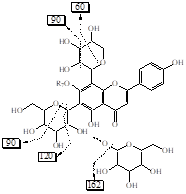
Химические исследования рода Silene ориентированы на изучение терпеновых соединений, том числе экдистероидов и тритерпеноидов. Малоизученными метаболитами рода являются флавоноиды, а именно С-/О-гликозилфлавоны, широко представленные в семействе Caryophyllaceae. Объектом настоящего исследования явился вид S. italica (L.) Pers., в ходе ранних исследований которого было выявлено присутствие некоторых С-гликозилфлавонов (Земцова, Джумырко, 1976; Darmograi, 1977), однако подробное изучение флавоноидов данного вида не проводилось. С применением высокоэффективной хроматографии с диодно-матричным и масс-спектрометрическим (ионизация электрораспылением) детектированием (ВЭЖХ-ДМД-ИЭР-МС) в надземной части S. italica, произрастающей в Грузии, было установлено наличие 14 флавоноидов, представляющих собой С-, О- и С,О-гликозиды флавонов, десять из которых – впервые для вида. Идентифицированные С-гликозиды включали моногликозиды изоориентин, изовитексин, изоскопарин (хризоэриол-6-С-глюкозид), и ди-гликозиды карлинозид (лютеолин-6-С-глюкозид-8-С-арабинозид), шафтозид (апигенин-6-С-глюкозид-8-С-арабинозид), изошафтозид (лютеолин-6-С-арабинозид-8-С-глюкозид) и генкванин-6-С-глюкозид-8-С-арабинозид. Два О-гликозида космосиин и цинарозид и смешанные С,О-гликозиды сапонарин, изовитексин-2′′-О-арабинозид, изовитексин-6′′-О-арабинозид и О-гексозиды шафтозида и генкванин-6-С-глюкозид-8-С-арабинозида были выявлены впервые для рода Silene. Известные сведения литературы (Mamadalieva et al., 2014) и полученные в настоящей работе данные свидетельствуют о том, что С-/О-гликозилфлавоны могут быть полезны для систематики рода Silene.
Скачивания
Литература
Mamadalieva N.Z., Lafont R., Wink M. Diversity, 2014, vol. 6, pp. 415–499. DOI: 10.3390/d6030415.
Mamadalieva N.Z. Bol. Latinoamer. Caribe Plantas Med. Arom., 2012, vol. 11, pp. 474–497.
Flora SSSR [Flora of the USSR], ed. V.L. Komarov. Moscow, Leningrad, 1936, vol. VI, pp. 577–691. (in Russ.).
Meng Y., Whiting P., Zibareva L., Bertho G., Girault J.-P., Lafont R., Dinan L. J. Chromatogr. A., 2001, vol. 935, pp. 309–319. DOI: 10.1016/S0021-9673(01)00893-7.
Zibareva L. Arch. In-sect. Biochem. Physiol, 2000, vol. 43, no. 1, pp. 1–8. DOI: 10.1002/(SICI)1520-6327(200001)43:1%3C1::AID-ARCH1%3E3.0.CO;2-D
Darmograi V.N. Chem. Nat. Comp., 1977, vol. 13, pp. 102–103. DOI: 10.1007/BF00566187.
Olennikov D.N., Kashchenko N.I. Chem. Nat. Comp., 2017, vol. 53, pp. 1199–1201. DOI: 10.1007/s10600-017-2239-1.
Olennikov D.N. Chem. Nat. Comp., 2019, vol. 55, pp. 107–110. DOI: 10.1009/s11720-012-2242-4.
Zemtsova G.N., Dzhumyrko S.F. Farmatsiya, 1976, vol. XXV, no. 3, pp. 26–29. (in Russ.).
Siewek F., Herrmann K. Grotjahn L., Wray V. Z. Naturforsch. C, 1985, vol. 40, pp. 8–12. DOI: 10.1515/znc-1985-1-204.
Wirasutisna K.R., Gleye J., Moulis C., Stanislas E., Moretti C. Phytochemistry, 1986, vol. 25, pp. 558–559. DOI: 10.1016/S0031-9422(00)85531-4.
Hostettmann K., Jacot-Guillarmod A. Helv. Chim. Acta, 1976, vol. 59, pp. 1584–1591. DOI: 10.1002/hlca.19760590517.
Bouillant M.L., Ferreres de Arce F., Favre-Bonvin J., Chopin J., Zoll A., Mathieu G. Phytochemistry, 1984, vol. 23, pp. 2653–2657. DOI: 10.1016/S0031-9422(00)84119-9.
Olennikov D.N., Chirikova N.K., Kashchenko N.I., Nikolaev V.M., Kim S.-W., Vennos C. Front. Pharmacol., 2018, vol. 9, article 756. DOI: 10.3389/fphar.2018.00756.
Olennikov D.N., Kashchenko N.I., Chirikova N.K., Gornostai T.G., Selyutina I.Yu., Zilfikarov I.N. Int. J. Molec. Sci., 2017, vol. 18, E2579. DOI: 10.3390/ijms18122579.
Li Q., Wang L., Dai P., Zeng X., Qi X., Zhu L., Yan T., Wang Y., Lu L., Hu M., Wang X., Liu Z. J. Chromatogr. A, 2015, vol. 1395, pp. 116–128. DOI: 10.1016/j.chroma.2015.03.069.
Chopin M.J., Bouillant M.L., Wagner H., Galle K. Phytochemistry, 1974, vol. 13, pp. 2583–2586. DOI: 10.1016/S0031-9422(00)86940-X.
Oxelman B., Rautenberg A., Thollesson M., Larsson A., Frajman B., Eggens F., Petri A., Aydin Z., Töpel M., Brandtberg-Falkman A. Sileneae taxonomy and systematics, 2013, URL: http://www.sileneae.info.
Copyright (c) 2019 Химия растительного сырья

Это произведение доступно по лицензии Creative Commons «Attribution» («Атрибуция») 4.0 Всемирная.

This work is licensed under a Creative Commons Attribution 4.0 International License.
Авторы, которые публикуются в данном журнале, соглашаются со следующими условиями:
1. Авторы сохраняют за собой авторские права на работу и передают журналу право первой публикации вместе с работой, одновременно лицензируя ее на условиях Creative Commons Attribution License, которая позволяет другим распространять данную работу с обязательным указанием авторства данной работы и ссылкой на оригинальную публикацию в этом журнале.
2. Авторы сохраняют право заключать отдельные, дополнительные контрактные соглашения на неэксклюзивное распространение версии работы, опубликованной этим журналом (например, разместить ее в университетском хранилище или опубликовать ее в книге), со ссылкой на оригинальную публикацию в этом журнале.
3. Авторам разрешается размещать их работу в сети Интернет (например, в университетском хранилище или на их персональном веб-сайте) до и во время процесса рассмотрения ее данным журналом, так как это может привести к продуктивному обсуждению, а также к большему количеству ссылок на данную опубликованную работу.