ФЕРМЕНТАТИВНЫЙ ГИДРОЛИЗ ЛИГНОЦЕЛЛЮЛОЗНОГО ОСТАТКА ПОСЛЕ КСИЛИТНОЙ ВАРКИ
УДК 661.124

Аннотация
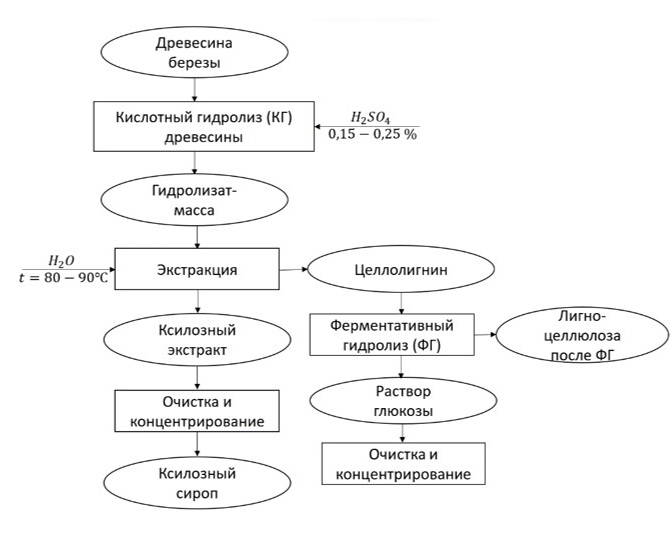
Предварительная обработка лигноцеллюлозного растительного сырья является важным этапом для получения глюкозы ферментативными методами. В результате кислотной обработки растительного сырья и растворения его гемицеллюлозной части происходит образование ксилозного раствора и разрыхление структуры нерастворимого остатка. В статье рассмотрена реакционная способность целлолигнина после ксилитной варки березовой древесины при различном расходе кислоты на процесс гидролиза. Выход продуктов при завершении процесса ферментативного гидролиза в образце, обработанном с повышенным расходом кислоты (6.25 г/ кг асд), составил 33.3 г/л, что на 55.6% выше, чем в случае образца, обработанного меньшим количеством кислоты (расход 3.75 г/кг асд). Выход продуктов при ферментативном гидролизе исходной древесины березы составил 8 г/л, таким образом, реакционная способность образцов лигноцеллюлозного остатка при ферментативном гидролизе увеличивается с увеличением расхода кислоты при ксилитной варке соответственно с 2.2 и 4 раза. На практике целесообразно комбинировать процессы ксилитной варки и ферментативного гидролиза для более эффективного использования ксилансодержащего сырья, получения ксилозы и глюкозы для последующего получения продуктов с добавленной стоимостью.
Скачивания
Литература
Silva T.P., Cordeiro de Assis G., Santana N.B., Tavares I.M.C., Santos P.H., Salay L.C., Iqbal M.W., Bilal M., Franco M. Valorization of Biomass to Bioproducts. Elsevier, 2023, pp. 1–26. https://doi.org/10.1016/B978-0-12-822887-6.00005-X.
Ravella S., Gallagher J., Fish S., Prakasham R.S. D-Xylitol. Berlin, Heidelberg: Springer, 2012, pр. 291–306. https://doi.org/10.1007/978-3-642-31887-0_13.
Mambetova S.R., Bakhtiyarova A.V., Mikhaylova A.Ye. Tendentsii razvitiya nauki i obrazovaniya, 2023, no. 100-2, pp. 112–114. https://doi.org/10.18411/trnio-08-2023-88. (in Russ.).
Prakasham R.S., Rao R.S., Hobbs P.J. Curr. Trends. Biotechnol. Pharm., 2009, vol. 3, pp. 8–36.
Arcano Y.D., Valma na Garcıa O.D., Mandelli D., Carvalho W.A., Magalhaes Pontes L.A. Catalysis Today, 2020, vol. 344, pp. 2–14. https://doi.org/10.1016/j.cattod.2018.07.060.
Deng W., Feng Y., Fu J. et. al. Green Energy & Environment, 2023, vol. 8, no. 1, pp. 10–114. https://doi.org/10.1016/j.gee.2022.07.003.
Patent 2142999 (RU). 20.12.1999. (in Russ.).
Bolotnikova T.A., Bazarnova Yu.G., Aronova Ye.B., Bolotnikova O.I. Nedelya nauki SPbPU: materialy nauchnoy konferentsii s mezhdunarodnym uchastiyem. [Science Week of SPbPU: Proceedings of a scientific conference with in-ternational participation]. St. Peterburg, 2019, vol. 1, pp. 6–8. (in Russ.).
Satyavolu J., Ganesh Dattatreya Tadimeti J., Thilakaratne R. Energy Conversion and Management: X, 2021, vol. 10, 100073. https://doi.org/10.1016/j.ecmx.2020.100073.
Zhu J.Y., Pan X. Renewable and Sustainable Energy Reviews, 2022, vol. 164, 112583. https://doi.org/10.1016/j.rser.2022.112583.
Sharapova I.E. Butlerovskiye soobshcheniya, 2018, vol. 56, no. 11, pp. 140–145. (in Russ.).
Dontsov A.G., Sharapova I.E. Butlerovskiye soobshcheniya, 2018, vol. 56, no. 11, pp. 146–152. (in Russ.).
Bakhtiyarova A.V., Belousov I.I., Kind A.V., Romanenko K.A., Spitsyn A.A. Khimicheskaya tekhnologiya, 2019, vol. 20, no. 3, pp. 98–103. https://doi.org/10.31044/1684-5811-2019-20-3-98-103. (in Russ.).
Purnawan A., Thontowi A., Kholida L.N., dan Urip Perwitasari U. Jurnal Ilmu Lingkungan, 2021, vol. 19(3), pр. 485–496. https://doi.org/10.14710/jil.19.3.485-496.
El Hage M., Louka N., Rezzoug S.-A., Maugard T., Sablé S., Koubaa M., Debs E., Maache-Rezzoug Z. Energies, 2023, vol. 16, 5052. https://doi.org/10.3390/en16135052.
Santos V.T.D.O., Siqueira G., Milagres A.M.F., Ferraz A. Ind. Crop. Prod., 2018, vol. 111, pp. 722–730. https://doi.org/10.1016/j.indcrop.2017.11.053.
Bakanov V.V., Vedernikov D.N., Khabarova L.S. Khimiya rastitel'nogo syr'ya, 2020, no. 3, pp. 67–72. https://doi.org/10.14258/jcprm.2020037277.
Ruiz-Matute A.I. et al. J. Chromatogr. B, 2011, vol. 879, pp. 1226–1240. https://doi.org/10.1016/j.jchromb.2010.11.013.
Mukhutdinov R.R., Pilipenko T.V., Kruchina-Bogdanov I.V. Vestnik YuUrGU. Seriya «Pishchevyye i biotekhnologii», 2019, no. 4, pp. 75–84. (in Russ.).
Sinitsyn A.P., Gusakov A.V., Chernoglazov V.M. Biokonversiya lignotsellyuloznykh materialov: ucheb. posobiye. [Bioconversion of lignocellulosic materials: textbook]. Moscow, 1995, 224 p. (in Russ.).
Dotsenko G.S., Chekushina A.V., Kondrat'yeva Ye.G., Pravil'nikov A.G., Andrianov R.M., Osipov D.O., Sinitsyna O.A., Korotkova O.G., Stepanov V.I., Novozhilov Ye.V., Achil'diyev Ye.R., Konstantinova S.A., Sinitsyn A.P., Lesnoy vestnik Moskovskogo gosudarstvennogo universiteta lesa, 2012, no. 8 (91), pp. 129–134. (in Russ.).
Copyright (c) 2025 Химия растительного сырья

Это произведение доступно по лицензии Creative Commons «Attribution» («Атрибуция») 4.0 Всемирная.

This work is licensed under a Creative Commons Attribution 4.0 International License.
Авторы, которые публикуются в данном журнале, соглашаются со следующими условиями:
1. Авторы сохраняют за собой авторские права на работу и передают журналу право первой публикации вместе с работой, одновременно лицензируя ее на условиях Creative Commons Attribution License, которая позволяет другим распространять данную работу с обязательным указанием авторства данной работы и ссылкой на оригинальную публикацию в этом журнале.
2. Авторы сохраняют право заключать отдельные, дополнительные контрактные соглашения на неэксклюзивное распространение версии работы, опубликованной этим журналом (например, разместить ее в университетском хранилище или опубликовать ее в книге), со ссылкой на оригинальную публикацию в этом журнале.
3. Авторам разрешается размещать их работу в сети Интернет (например, в университетском хранилище или на их персональном веб-сайте) до и во время процесса рассмотрения ее данным журналом, так как это может привести к продуктивному обсуждению, а также к большему количеству ссылок на данную опубликованную работу.