COMPONENT COMPOSITION OF THE ESSENTIAL OIL OF MYRICA GALE L. FROM INTRODUCTION
UDC 582.883: 547.913

Abstract
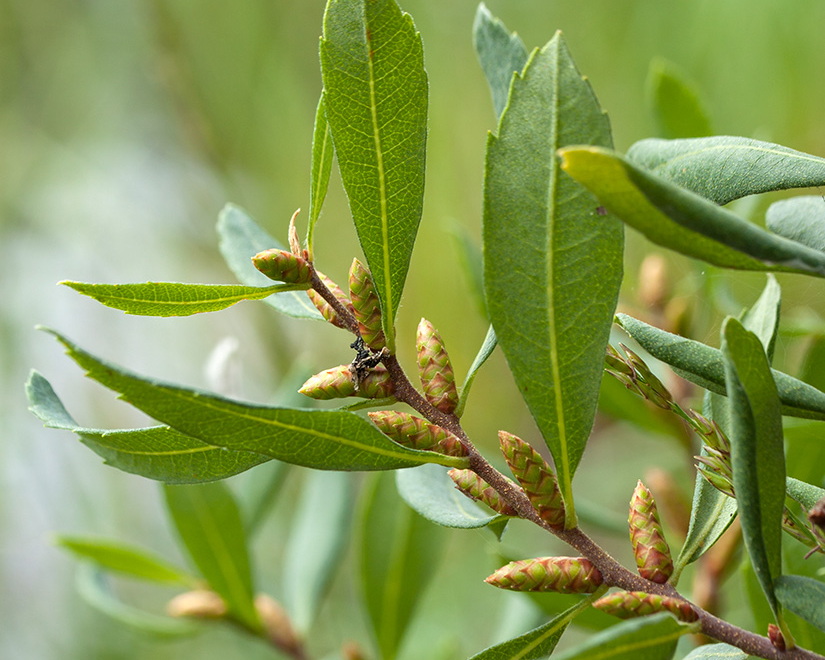
Myrica gale L. (Myricaceae) is one of the rare and protected plant species in Russia. In 2011, during the construction of a section of the intracity toll highway in St. Petersburg, the route was laid through the Yuntolovsky forest park, where there was a significant population of Myrica gale. Some of the plants were transplanted to the territory of the Yuntolovsky reserve, and some to the park of the Komarov Botanical Institute RAS (St. Petersburg). In this work, the component composititon of the essential oil of Myrica gale leaves growing in new locations was studied. The essential oil was obtained by hydrodistillation. The yield of essential oil from Myrica gale leaves collected on the territory of the Yuntolovsky reserve ranged from 0.21 to 1.55%. 52 components were identified, among which the main ones were (Z)-nerolidol (15.71%), germacrene B (11.47%), δ-cadinene (9,76 %), an unidentified component Un 1532 with tR=19.92 min (9.34%) and 1,10-di-epi-cubenol (5.61%). The yield of essential oil from Myrica gale leaves collected on the territory of BIN RAS park is from 0.09% to 0.13%. 49 components were identified, among which the predominant ones were δ-cadinene (14.11%), 1,10-di-epi-cubenol (8.59%), (Z)-nerolidol (8.43%), 1,8-cineole (6.01%) и (Е)-caryophyllene (5.01%). It was determined that in the studied populations the prosess of formation of acyclic sesquiterpene alcohols dominates, which leads to a significant accumulation of nerolidol. In general, a change in the habitat of Myrica gale (transplantation of some plants into the Yuntolovsky reserve and the park of the BIN RAS) did not significantly affect the terpene profile of the essential oil.
Downloads
References
Skene K., Sprent J., Herdman L. J. Ecol., 2000, vol. 88(6), pp. 1079–1094.
olchennikova I.O., Antonova I.S. Trudy instituta biologii vnutrennikh vod im. I.D. Papanina RAN, 2021, no. 95 (98), pp. 52–62. https://doi.org/10.47021/0320-3557-2021-52-62. (in Russ.).
Volkova Ye.A., Smagin V.A., Khramtsov V.N. Rastitel'nost' Rossii, 2021, no. 41, pp. 58–74. https://doi.org/10.31111/vegrus/2021.41.58. (in Russ.).
Krasnaya kniga Rossiyskoy Federatsii. Rasteniya i griby. [Red Data Book of the Russian Federation. Plants and fungi]. Moscow, 2008. (in Russ.).
Davey A., Gibson C. New Phytologist, 1917, vol. 74, pp. 147–151.
Huguet V., Mergeay M., Cervantes E., Fernandez M.P. Environment. Microbiol., 2004, vol. 6, no. 10, pp. 1032–1041. https://doi.org/10.1111/j.1462-2920.2004.00625.x.
Uyar T., Malterud K.E., Anthonsen T. Phytochemistry, 1978, vol. 17(11), pp. 2011–2013. https://doi.org/10.1016/S0031-9422(00)88753-1.
Malterud K.E., Diep O.H., Sund R.B. Pharmacol. Toxicol., 1996, vol. 78(2), pp. 111–116. https://doi.org/10.1111/j.1600-0773.1996.tb00190.x.
Fang J., Paetz C., Schneider B. Biochem. Syst. Ecol., 2011, vol. 39(1), pp. 68–70. https://doi.org/10.1016/j.bse.2011.01.009.
Carlton R., Waterman P., Gray A. Chemoecology, 1992, vol. 3, pp. 45–54. https://doi.org/10.1007/bf01261456.
Simpson M.J.A., Maclntosh D.F., Cloughley J.B., Stuart A.E. Economic Bot., 1996, vol. 50(1), pp. 122–129.
Sylvestre M., Legault J., Dufour D., Pichette A. Phytomedicine, 2005, vol. 12(4), pp. 299–304. https://doi.org/10.1016/j.phymed.2003.12.004.
Kashina A.A., Gurina S.V., Yakovlev G.P. Rastitel'nyye resursy, 2009, vol. 49(2), pp. 127–133. (in Russ.).
Krogsbøll L., Karring H., Christensen L.P. Planta Med., 2016, vol. 82, pp. 1–381. https://doi.org/10.1055/s-0036-1596460.
Tkachev A.V. Khimiya rastitel'nogo syr'ya, 2017, no. 3, pp. 5–37. https://doi.org/10.14258/jcprm.2017032712. (in Russ.).
Adams R.P. Identification of essential oil components by gas chromatography/mass spectroscopy. Allured business media, Carol stream, 2007, 804 p.
Babushok V.I., Linstrom P.J., Zenkevich I.G. J. Phys. Chem. Ref. Data, 2011, vol. 40(4), 043101. https://doi.org/10.1063/1.3653552.
Halim A.F., Collins R.P. Phytochemistry, 1973, vol. 12(5), pp. 1077–1083. https://doi.org/10.1016/0031-9422(73)85019-8.
Svoboda K., Inglis A., Hampson J., Galambosi B., Asakawa Y. Flavour Fragr. J., 1998, vol. 13, pp. 367–372. https://doi.org/10.1002/(SICI)1099-1026(199811/12)13:6<367::AID-FFJ724>3.0.CO;2-M.
Ložienė K., Labokas J., Vaičiulytė V., Švedienė J., Raudonienė V., Paškevičius A., Šveistytė L., Apšegaitė V. Baltic Forestry, 2020, vol. 26(1), 423. https://doi.org/10.46490/BF423.
Popovici J., Bertran C., Bagnarol E., Fernandez M.P., Comte G. Nat. Prod. Res., 2008, vol. 22(2), pp. 1024–1032. https://doi.org/10.1080/14786410802055568.
Wawrzyńczak K., Jakiel A., Kalemba D. Biotechnol. Food Chem., 2019, vol. 83(1), pp. 87–96. https://doi.org/10.34658/bfs.2019.83.1.87-96.
Fiehn O., Robertson D., Griffin J., Werf M., Nikolau B., Morrison N. Metabolomics: official journal of the metabo-lomics society, 2007, vol. 3(3), pp. 175–178. https://doi.org/10.1007/s11306-007-0070-6.
Nagar S., Pigott M., Whyms S., Berlemont A., Sheridan H. Separations, 2023, vol. 10, 128. https://doi.org/10.3390/separations10020128.
Chan W.K., Tan L.T.H., Chan K.G., Lee L.H., Goh B.H. Molecules, 2016, vol. 21(5), 529. https://doi.org/10.3390/molecules21050529.
Cai Z.M., Peng J.Q., Chen Y., Tao L., Zhang Y.Y., Fu L.Y., Long Q.D., Shen X.C. J. Asian Nat. Prod. Res., 2021, vol. 23(11), pp. 938–954. https://doi.org/10.1080/10286020.2020.1839432.
Borges M.F.A., Lacerda R.S., Correia J.P.A., de Melo T.R., Fereira S.B. Med. Sci. Forum, 2022, vol. 12(1), 11. https://doi.org/10.3390/eca2022-12709.
Copyright (c) 2025 Chemistry of plant raw material

This work is licensed under a Creative Commons Attribution 4.0 International License.

This work is licensed under a Creative Commons Attribution 4.0 International License.
The authors, which are published in this journal, agree to the following conditions:
1. Authors retain the copyright to the work and transfer to the journal the right of the first publication along with the work, at the same time licensing it under the terms of the Creative Commons Attribution License, which allows others to distribute this work with the obligatory indication of the authorship of this work and a link to the original publication in this journal .
2. The authors retain the right to enter into separate, additional contractual agreements for the non-exclusive distribution of the version of the work published by this journal (for example, to place it in the university depository or to publish it in a book), with reference to the original publication in this journal.
3. Authors are allowed to post their work on the Internet (for example, in a university repository or on their personal website) before and during the review process of this journal, as this may lead to a productive discussion, as well as more links to this published work.