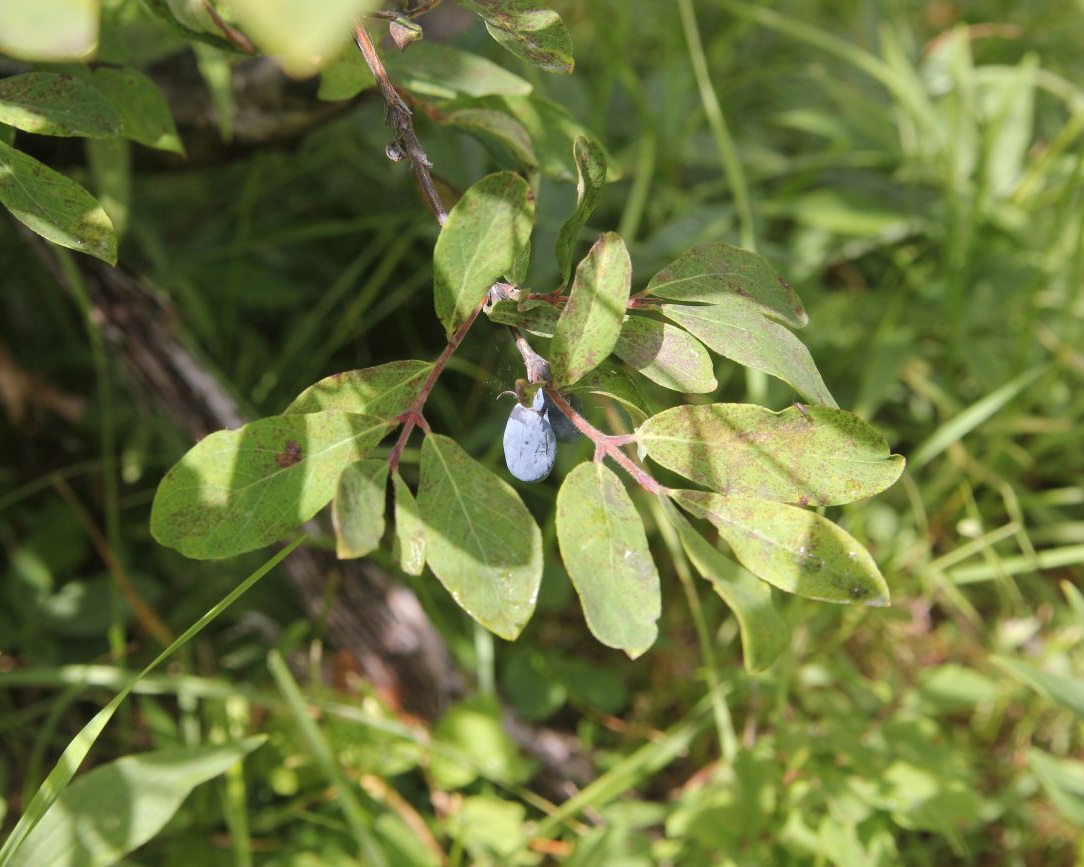
VARIABILITY OF MACRO- AND TRACE ELEMENTS CONTENT IN LONICERA CAERULEA SUBSP. ALTAICA (CAPRIFOLIACEAE) AS RELATED TO THE POLYPHENOLS CONTENT AND HABITAT ALTITUDE
UDC 574.927:581.192: 582.973:581.52:631.411:577.13:543.544.5.68.7

Abstract
To study the variability of macro- and trace elements content in the soil-plant system in Lonicera caerulea subsp. Altaica populations and chemical elements relationship with polyphenolic compounds composition at different habitat altitudes in the River Multa valley (Mountain Altai) soil and plant samples were collected at eight study sites at the altitudes from 1072 up to 1850 m a.s.l. The samples collected were analyzed by atomic emission spectrometry; the mobile forms of trace elements were determined in acetate-ammonium buffer (pH 4.8) atomic absorption spectrometry. The polyphenol content in phytomass was determined by HPLC. Correlation analysis was performed between the chemical elements content and individual classes and groups of polyphenols.
The data analysis revealed significant variation of chemical elements content in plants as related with their growing site location. The content of Ni, Cu and Zn in leaves, K, Ni, Pb and Y in stems and the accumulation rate of K, Ca, Mg and Sr were found to be positively correlated with the altitude, whereas the content of Ca, Mg, Na, Ba, Cr, Cd, Mo, Pb, Sr, V and Y, as well as the accumulation rate of Cu, Fe, Na and Zn, on the contrary, showed statistically significant decrease with the altitude. Physiologically meaningful ratios of some elements, such as Cu/Zn, K/Ca and Fe/Mn in leaves varied little, ranging 0.2-0.6; 0.8-1.9 and 0.5-2.0, respectively. The K/Ca ratio in plant organs showed statistically significant increase with the altitude, whereas the Ca/Na in leaves decreased. The flavons accumulation rates had statistically significant positive or negative correlations with Co and K content in leaves, Na, Zn and Ni in stems, with accumulation rate of such biophilic elements as Cu and Mg, as well as with K/Na in leaves and Ca/Na in stems. The hydrocinnamic acid derivatives were shown to have statistically significant correlation with some elements, i.e. negative with Cu, Co and Mn content, and positive with La and Mo content in leaves. The accumulation rate of flavonols was negatively correlated with Cd, Na, Mn and Zn and positively correlated with K/Na ratio in stems. Soil content of mobile Cu and Ni showed statistically significant correlation with the flavons content, whereas labile Cr was correlated with hydrocinnamic acids.
Downloads
References
Palikova I., Heinrich J., Bednar P., Marhol P., Kren V., Cvak L., Valentova K., Ruzicka F., Hola V., Kolar M., Simanek V., Ulrichova J. J. Agric. Food Chem., 2008, vol. 56, pp. 11883–11889. https://doi.org/10.1021/jf8026233.
Jurikova T., Rop O., Mlcek J., Sochor J., Balla S., Szekeres L., Hegedusova A., Hubalek J., Adam V., Kizek R. Mole-cules, 2012, vol. 17, pp. 61–79. https://doi.org/10.3390/molecules17010061.
Boyarskikh I.G. Vasil'yev V.G. Kukushkina T.A. Rastitel'nyye resursy, 2014, no.1, pp. 105–121. (in Russ.).
Celli G.B., Ghanem A., Su Ling Brooks M. Food Bioprocess Technol., 2014, vol. 7, pp. 1541–1554. https://doi.org/10.1007/s11947-014-1301-2.
Kucharska A.Z., Sokół-Łętowska A., Oszmiański J., Piórecki N., Fecka I. Molecules, 2017, vol. 22(3), 405. https://doi.org/10.3390/molecules22030405.
Oszmiański J., Kucharska A.Z. Food Chemistry, 2018, vol. 240, pp. 1087–1091. https://doi.org/10.1016/j.foodchem.2017.08.049.
Boyarskikh I.G., Syso A.I, Khudyayev S.A. Rastitel'nyye resursy, 2013, no.4, pp. 571–585. (in Russ.).
Boyarskikh I.G., Syso A.I., Siromlya T.I. Sibirskiy ekologicheskiy zhurnal, 2019, no. 6, pp. 727–741. https://doi.org/10.15372/SEJ20190608. (in Russ.).
Senica M., Bavec M., Stampara F., Mikulic-Petkovseka M. J. Sci. Food Agric., 2018, vol. 98, pp. 3333–3342. https://doi.org/10.1002/jsfa.8837.
Minami M., Nakamura M., Makino T. Hindawi Bio Med Research International, 2019, vol. 2019, 1797930. https://doi.org/10.1155/2019/1797930.
Negi J.S., Singh P., Nee Pant G.J., Rawat M.S.M., Pandey H.K. Biological Trace Element Research, 2009, vol. 135(1-3), pp. 275–282. https://doi.org/10.1007/s12011-009-8485-8.
Dong T., Sha Y., Liu H., Sun L. Molecules, 2021, vol. 26, 7383. https://doi.org/10.3390/molecules26237383.
Spitaler R., Schlorhaufer P.D., Ellmerer E.P., Merfort I., Bortenschlager S., Stuppner H., Zidorn C. Phytochemistry, 2006, vol. 67, pp. 409–417. https://doi.org/10.1016/j.phytochem.2005.11.018.
Rieger G., Mu¨ller M., Guttenberger H., Bucar F. J. Agric. Food Chem., 2008, vol. 56, pp. 9080–9086. https://doi.org/10.1021/jf801104e.
Khramova Ye.P. Rastitel'nyye resursy, 2014, no. 50(4), pp. 627–639. (in Russ.).
Alonso-Amelot M.E., Oliveros-Bastidas A., Calcagno-Pisarelli M.P. BiochemSyst Ecol., 2007, vol. 35, pp. 1–10. https://doi.org/10.1016/j.bse.2006.04.013.
Ganzera M., Guggenberger M., Stuppner H., Zidorn C. Planta Med., 2008, vol. 74, pp. 453–457. https://doi.org/10.1055/s-2008-1034326.
Xenophontos M., Stavropoulos I., Avramakis E., Navakoudis E., Dornemann D., Kotzabasis K. Planta Med., 2008, vol. 74, pp. 1496–1503. https://doi.org/10.1055/s-2008-1081337.
Ni Q., Wang Z., Xu G., Gao Q., Yang D., Morimatsu F., Zhang Y. J. Nutr. Sci. Vitaminol., 2013, vol. 59, pp. 336–342.
Senica M., Stampar F., Veberic R., Mikulic-Petkovsek M. J. Sci. Food Agric., 2017, vol. 97, pp. 2623–2632. https://doi.org/10.1002/jsfa.8085.
Chanishvili Sh., Badridze G., Rapava L., Dzhanukashvili N. Ekologiya, 2007, no. 56, pp. 395–401. (in Russ.).
Sharaf A.E.-M.A., Khafagi O.-M.A., Hatab E.-B.E., Moursy M.M. Middle-East Journal of Scientific Research, 2013, vol. 14, pp. 122–129. https://doi.org/10.5829/idosi.mejsr.2013.14.1.2006.
Acuña-Avila P.E., Vásquez-Murrieta M.S., Hernández M.O.F., López-Cortéz M.D.S. Food Chem., 2016, vol. 203, pp. 79–85. https://doi.org/10.1016/j.foodchem.2016.02.031.
Hanaka A., Dresler S., Wójciak-Kosior M., Strzemski M., Kováˇcik J., Latalski M., Zawi´slak G., Sowa I. Molecules, 2019, vol. 24, 3825. https://doi.org/10.3390/molecules24213825.
Boyarskikh I.G., Syromlya T.I. Chemistry for Sustainable Development, 2022, vol. 30, pp. 341–353. https://doi.org/10.15372/CSD2022.
Körner C. Alpine plant life. Functional plant ecology of high mountain ecosystems. Springer. Berlin, 1999, 344 p.
Bilger W., Rolland M., Nybakken L. Photochemical & Photobiological Sciences, 2007, vol. 6, pp. 190–195. https://doi.org/10.1039/b609820g.
Boyarskikh I.G., Kostikova V.A. Khimiya rastitel'nogo syr'ya, 2024, no.1, pp. 195–203. https://doi.org/10.14258/jcprm.20240112977. (in Russ.).
Перельман А.И., Касимов Н.С. Геохимия ландшафта. М., 1999. 610 с. (in Russ.).
Glantz S.A. Primer of Biostatistics. 7th ed. New York, 2012. 320 p.
Dokuchayev V.V. K ucheniyu o zonakh prirody: Gorizontal'nyye i vertikal'nyye pochvennyye zony. [Towards the doc-trine of natural zones: Horizontal and vertical soil zones]. St. Petersburg, 1899, 28 p. (in Russ.).
Syso A.I. Zakonomernosti raspredeleniya khimicheskikh elementov v pochvoobrazuyushchikh porodakh i pochvakh Zapadnoy Sibiri. [Patterns of distribution of chemical elements in parent rocks and soils of Western Siberia]. Novosi-birsk, 2007, 277 p. (in Russ.).
Syso A.I., Kolpashchikov L.A., Yermolov Yu.V., Cherevko A.S., Siromlya T.I. Sibirskiy ekologicheskiy zhurnal, 2014, no. 6, pp. 855–862. (in Russ.).
Kostenko I.V., Opanasenko N.Ye. Pochvovedeniye, 2020, no. 7, pp. 791–802. (in Russ.).
Sutormina E.N., Turun P.P., Polushkovskiy B.V. Izvestiya Dagestanskogo gosudarstvennogo pedagogicheskogo uni-versiteta. Yestestvennyye i tochnyye nauki, 2021, no. 15(2), pp. 108–116. https://doi.org/10.31161/1995-0675-2021-15-2-108-116. (in Russ.).
Кabata-Pendias A. Trace Elements in soils and plants. 4th ed. BocaRaton: CRCPress, 2011, 505 p. https://doi.org/10.1201/b10158.
Arzhanova P.V., Yelpat'yevskiy V.S. Geokhimiya landshaftov i tekhnogenez. [Geochemistry of landscapes and tech-nogenesis]. Moscow, 1990, 196 p. (in Russ.).
Bityutskiy N.P. Mikroelementy vysshikh rasteniy. [Microelements of Higher Plants]. St. Petersburg, 2020, 368 p. (in Russ.).
Copyright (c) 2025 chemistry of plant raw material

This work is licensed under a Creative Commons Attribution 4.0 International License.

This work is licensed under a Creative Commons Attribution 4.0 International License.
The authors, which are published in this journal, agree to the following conditions:
1. Authors retain the copyright to the work and transfer to the journal the right of the first publication along with the work, at the same time licensing it under the terms of the Creative Commons Attribution License, which allows others to distribute this work with the obligatory indication of the authorship of this work and a link to the original publication in this journal .
2. The authors retain the right to enter into separate, additional contractual agreements for the non-exclusive distribution of the version of the work published by this journal (for example, to place it in the university depository or to publish it in a book), with reference to the original publication in this journal.
3. Authors are allowed to post their work on the Internet (for example, in a university repository or on their personal website) before and during the review process of this journal, as this may lead to a productive discussion, as well as more links to this published work.