THE EFFECT OF HEAT TREATMENT OF PIGMENTED BARLEY AND WHEAT GRAINS ON ITS ANTIOXIDANT ACTIVITY
UDC 633.14: 631.52

Abstract
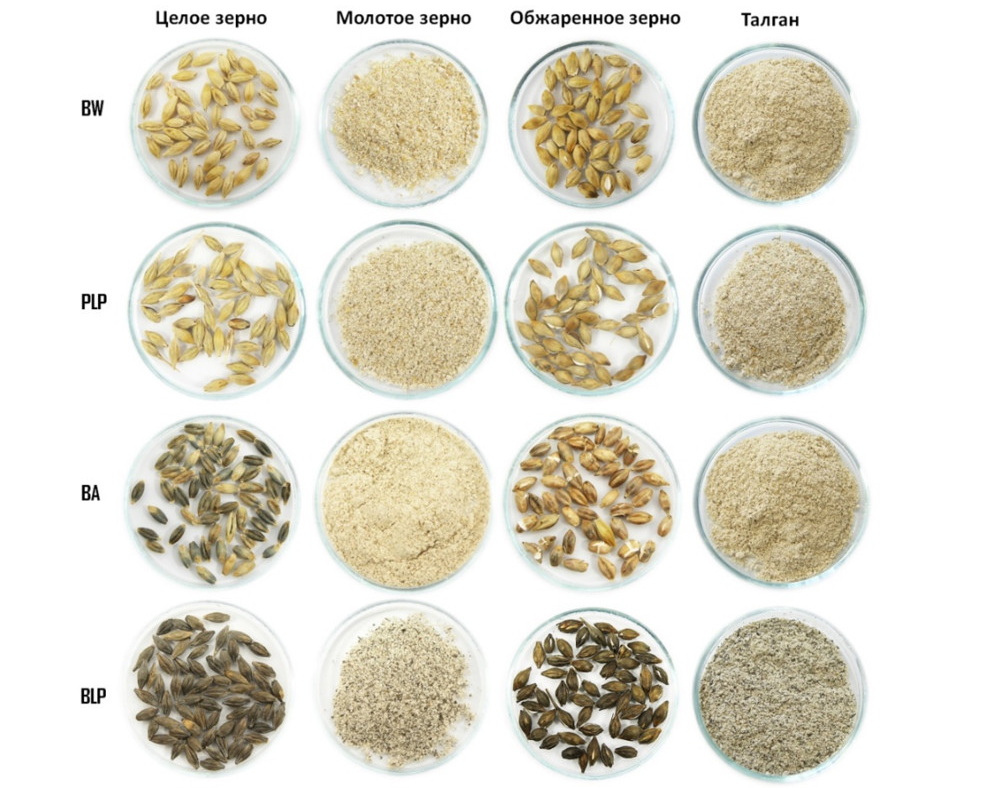
The purpose of this study is to analyze the effect of heat treatment of pigmented grain of near isogenic wheat and barley lines on the content of phenolic compounds and the antioxidant activity of the Khakass national product talgan, in the manufacture of which the grain is roasted and ground. The work was carried out using near isogenic wheat lines iP and barley PLP, BA, BLP, which differ from the control unpigmented lines iP7D and Bowman, respectively, by the presence of anthocyanin or melanin pigments in the grain. It was shown that pigmented wheat and barley grains contained 13–63% more phenolic compounds compared to the grain of the control lines. At the same time, the BLP barley line, which accumulates melanins in grain, was characterized by the highest content of phenolic compounds (3.04 mg/g), and the iP7D wheat line was characterized by the lowest (1.58 mg/g).
A strong positive correlation was found between the content of free phenolic compounds and the antioxidant activity of methanol extracts of grain (rs = 0.879, p<0.05). The talgan prepared from the tested grain showed an increase in the content of phenolic compounds by 8–43% compared to the initial grain. At the same time, pigmented grains were characterized by a higher content of phenolic compounds (wheat: 2.55 mg/g; barley: 2.55–3.48 mg/g) compared with grains of control lines (wheat: 2.03 mg/g; barley: 2.38 mg/g).
The value of the antioxidant activity of talgan extracts was either significantly higher (Bowman, iP7D, iP) or tended to increase (PLP, BA, BLP) compared with unprocessed grain, while there was a strong positive correlation between the content of free phenolic compounds and the antioxidant activity of talgan extracts (rs = 0.896, p<0.05). Thus, the results demonstrated that pigmented wheat and barley grains are promising raw materials for the production of a functional healthy food product, the national Khakass talgan.
Downloads
References
Francavilla A., Joye I.J. Nutrients, 2020, vol. 12, 2922. https://doi.org/10.3390/nu12102922.
Li D., Wang P., Luo Y., Zhao M., Chen F. Critical reviews in food science and nutrition, 2017, vol. 57, pp. 1729–1741. https://doi.org/10.1080/10408398.2015.1030064.
Yang X., Tang C., Zhao Q., Jia Y., Qin Y., Zhang J. Journal of Functional Foods, 2023, vol. 105, 105574. https://doi.org/10.1016/j.jff.2023.105574.
Usenko N.I., Khlestkina E.К., Asavasanti S., Gordeeva E.I., Yudina R.S., Otmakhova Y.S. Foods and Raw Materials, 2018, vol. 6, pp. 128–135. https://doi.org/10.21603/2308-4057-2018-1-128-135.
Sumina A.V., Polonskiy V.I., Shaldayeva T.M., Shulbayeva M.T. Vestnik KrasGAU, 2019, vol. 12, pp. 125–130. (in Russ.).
Wang B., Nie C., Li T., Zhao J., Fan M., Li Y., Qian H., Wang L. Food Research International, 2022, vol. 162, 112137. https://doi.org/10.1016/j.foodres.2022.112137.
Dhua S., Kheto A., Singh Sharanagat V., Singh L., Kumar K., Nema P.K. Food Chemistry, 2021, vol. 365, 130372. https://doi.org/10.1016/j.foodchem.2021.130372.
Drawbridge P.C., Apea-Bah F., Silveira Hornung P., Beta T. Food Chemistry, 2021, vol. 358, 129905. https://doi.org/10.1016/j.foodchem.2021.129905.
Sharma P., Goudar G., Longvah T., Gour Vinod. S., Kothari S.L., Wani I.A. Food Reviews International, 2022, vol. 38, pp. 163–198. https://doi.org/10.1080/87559129.2020.1725036.
Druka A., Franckowiak J., Lundqvist U., Bonar N., Alexander J., Houston K., Radovic S., Shahinnia F., Ven-dramin V., Morgante M., Stein N., Waugh R. Plant Physiology, 2011, vol. 155, no. 2, pp. 617–627. https://doi.org/10.1104/pp.110.166249.
Glagoleva A., Kukoeva T., Mursalimov S., Khlestkina E., Shoeva O. Agronomy, 2022, vol. 12, 112. https://doi.org/10.3390/agronomy12010112.
Shoeva O.Y., Mursalimov S.R., Gracheva N.V., Glagoleva A.Y., Börner A., Khlestkina E.K. Scientific Reports, 2020, vol. 10, 179. https://doi.org/10.1038/s41598-019-56982-y.
Arbuzova V.S., Maystrenko O.I., Popova O.M. Cereal Research Communications, 1998, vol. 26, pp. 39–46. https://doi.org/10.1007/BF03543466.
Gordeeva E.I., Shoeva O.Y., Khlestkina E.K. Euphytica, 2015, vol. 203, pp. 469–476. https://doi.org/10.1007/s10681-014-1317-8.
Kukoeva T.V., Molobekova C.A., Totsky I.V., Vasiliev G.V., Pronozin A.Y., Afonnikov D.A., Khlestkina E.K., Shoeva O.Y. Agronomy, 2024, vol. 14, 1231. https://doi.org/10.3390/agronomy14061231.
Abdel-Aal E.-S.M., Choo T.-M., Dhillon S., Rabalski I. Cereal Chemistry Journal, 2012, vol. 89, pp. 198–204. https://doi.org/10.1094/CCHEM-10-11-0116.
Polonskiy V.I., Sumina A.V., Shaldayeva T.M. Vestnik KrasGAU, 2017, vol. 12, pp. 21–28. (in Russ.).
Shawky E., Bassam S.M., Marzouk H.S., Ghareeb D.A., El Sohafy S.M. Food Research International, 2024, vol. 178, 113961. https://doi.org/10.1016/j.foodres.2024.113961.
Ragaee S., Seetharaman K., Abdel-Aal E.-S.M. Critical Reviews in Food Science and Nutrition, 2014, vol. 54, pp. 837–849. https://doi.org/10.1080/10408398.2011.610906.
Yamuangmorn S., Sreethong T., Saenchai C., Rerkasem B., Prom-u-thai C.T. International Food Research Journal, 2021, vol. 28, no. 1, pp. 73–82. https://doi.org/10.47836/ifrj.28.1.07.
Minh N.P. Plant Science Today, 2021, vol. 8, pp. 1075–1078. https://doi.org/10.14719/pst.2021.8.4.1294.
Copyright (c) 2026 Chemistry of plant raw material

This work is licensed under a Creative Commons Attribution 4.0 International License.

This work is licensed under a Creative Commons Attribution 4.0 International License.
The authors, which are published in this journal, agree to the following conditions:
1. Authors retain the copyright to the work and transfer to the journal the right of the first publication along with the work, at the same time licensing it under the terms of the Creative Commons Attribution License, which allows others to distribute this work with the obligatory indication of the authorship of this work and a link to the original publication in this journal .
2. The authors retain the right to enter into separate, additional contractual agreements for the non-exclusive distribution of the version of the work published by this journal (for example, to place it in the university depository or to publish it in a book), with reference to the original publication in this journal.
3. Authors are allowed to post their work on the Internet (for example, in a university repository or on their personal website) before and during the review process of this journal, as this may lead to a productive discussion, as well as more links to this published work.