RAINUTRIA JAPANESE: USE OF A MOST DANGEROUS INVASIVE PLANT
UDC 544.543.123:577.13

Abstract
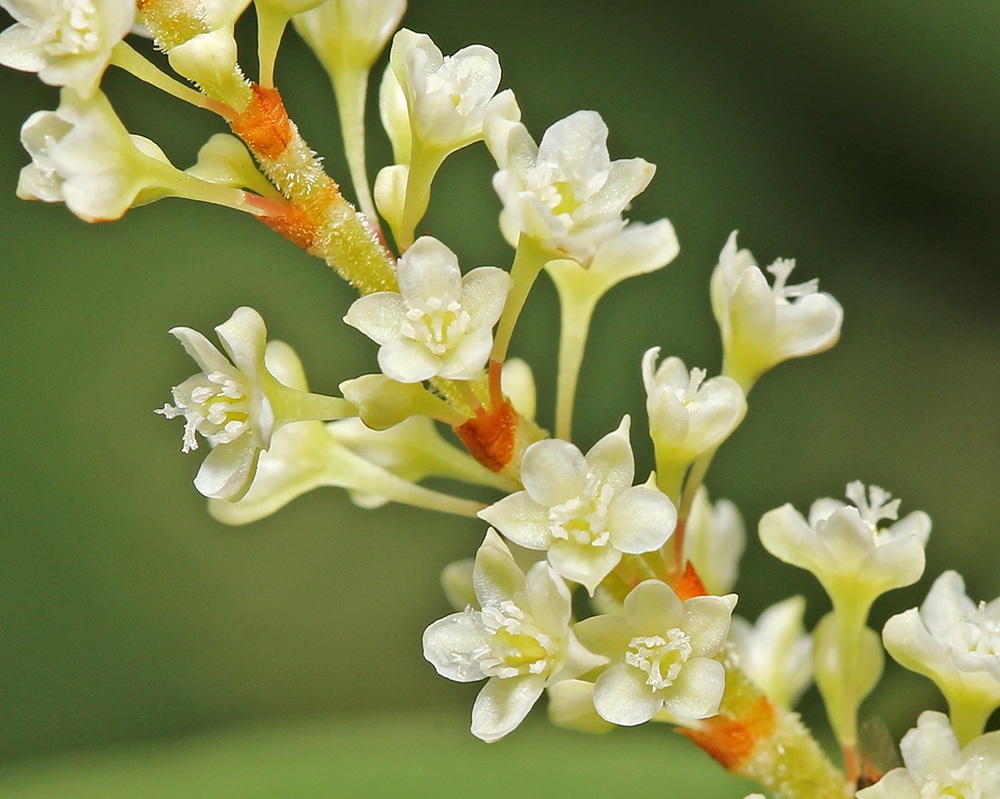
Young red-leaved seedlings of Reynoutria japonica Houtt. were studied. It was shown for the first time that the red coloring of the leaves of seedlings is due to the accumulation of two anthocyanins - cyanidin-3-glucoside (54% of the total anthocyanins) and cyanidin-3-rutinoside (45%), - from 350 to 450 mg per 100 g of dried plant material. The species composition of anthocyanins was determined by reverse-phase HPLC with spectrophotometric detection. In addition to anthocyanins, a substance with an electronic absorption spectrum characteristic of resveratrol derivatives was found in leaf chromatograms, but with significantly lower retention compared to resveratrol. This substance, in accordance with the literature, was identified as resveratrol glucoside - polydatin, with an accumulation level of 90 to 150 mg per 100 g of dried plant material. These same substances are also found in the aqueous infusion, which allows the resulting material to be considered as a potentially important additive to green or black tea and when blended with other plant material. Moreover, the concentration of polydatin can be an order of magnitude higher than the concentration of this substance in red wines, allowing this dangerous invasive plant to be used for the benefit of humans.
Downloads
References
Motyl' M., Bakey S. Nauka i innovatsii, 2019, no. 10 (200), pp. 71–74. (in Russ.).
Tokhtar' V.K., Reshetnikova N.M., Kurskoy A.Yu., Zelenkova V.N., Tret'yakov M.Yu. Chernaya kniga flory Belgo-rodskoy oblasti. Monografiya. [Black Book of Flora of the Belgorod Region. Monograph]. Belgorod, 2023, 252 p. (in Russ.).
Khalil A.A.K., Akter K.-M., Kim H.-J., Park W.S., Kang D.-M., Koo K.A., Ahn M.-J. Plants, 2020, vol. 9, 222. https://doi.org/10.3390/plants9020222.
Patocka J., Navratilova Z., Ovando M. Mil. Med. Sci. Lett., 2017, vol. 86, pp. 1–15. https://doi.org/10.31482/mmsl.2017.004.
Alperth F., Melinz L., Fladerer J.-P., Bucar F. Plants, 2021, vol. 10, 1809. https://doi.org/10.3390/plants10091809.
Liu S., Zhang R., Zhang X., Zhu S., Liu S., Yang J., Li Z., Gao T., Liu F., Hu H. Front. Pharmacol., 2022, vol. 13, 863707. https://doi.org/10.3389/fphar.2022.863707.
Ravagnan G., De Filippis A., Cartenì M., De Maria S., Cozza V., Petrazzuolo M., Tufano M.A., Donnaruma G. In-flammation, 2013, vol. 36, pp. 26–34. https://doi.org/10.1007/s10753-012-9516-8.
Jeandet P., Clément C., Courot E., Cordelier S. Int. J. Mol. Sci., 2013, vol. 14, pp. 14136–14170. https://doi.org/10.3390/ijms14071413614.
Vrchotová N., Šerá B., Tříska J. Acta Chromatographica, 2007, vol. 19, pp. 21–28.
Gould K.S. J. Biomed. Biotechnol., 2004, vol. 5, pp. 314–320. https://doi.org/10.1155/S1110724304406147.
Giusti M.M., Wrolstad R.E. Curr. Protoc. Food Anal. Chem., 2001, pp. F1.2.1–F1.2.13. https://doi.org/10.1002/0471142913.faf0102s00.
Nguyen H.T., Nguyen T.T., Nguyen X.C., Duong V.C., Dong V.Q., Sailesh M. World J. Microbiol. Biotechnol., 2018, vol. 34, 75. https://doi.org/10.1007/s11274-018-2458-z.
Kirino A., Takasuka Y., Nishi A., Kawabe S., Yamashita H., Kimoto M., Ito H., Tsuji H. J. Nutr. Sci. Vitaminol., 2012, vol. 58, pp. 278–286. https://doi.org/10.3177/jnsv.58.278.
Deyneka L.A., Shaposhnik Ye.I., Gostishchev D.A., Deyneka V.I., Sorokopudov V.N., Selemenev V.F. Sorbtsionnyye i khromatograficheskiye protsessy, 2009, vol. 9, pp. 529–536. (in Russ.).
Deineka L.A., Sidorov A.N., Deineka V.I., Kul’chenko Ya.Yu., Blinova I.P. J. Anal. Chem., 2020, vol. 75, pp. 754–758. https://doi.org/10.1134/S1061934820060064.
Sun A.Y., Simonyi A., Sun G.Y. Free Radical Biol. Med., 2002, vol. 32, pp. 314–318. https://doi.org/10.1016/s0891-5849(01)00803-6.
Rivero-Pérez M.D., Muñiz P., González-Sanjosé M.L. Food Chem. Toxicol., 2008, vol. 46, pp. 2815–2822. https://doi.org/10.1016/j.fct.2008.05.014.
Sato M., Suzuki Y., Okuda T., Yokotsuka K. Biosci. Biotech. Biochem., 1997, vol. 61, pp. 1800–1805. https://doi.org/10.1271/bbb.61.1800.
Copyright (c) 2025 Chemistry of plant raw material

This work is licensed under a Creative Commons Attribution 4.0 International License.

This work is licensed under a Creative Commons Attribution 4.0 International License.
The authors, which are published in this journal, agree to the following conditions:
1. Authors retain the copyright to the work and transfer to the journal the right of the first publication along with the work, at the same time licensing it under the terms of the Creative Commons Attribution License, which allows others to distribute this work with the obligatory indication of the authorship of this work and a link to the original publication in this journal .
2. The authors retain the right to enter into separate, additional contractual agreements for the non-exclusive distribution of the version of the work published by this journal (for example, to place it in the university depository or to publish it in a book), with reference to the original publication in this journal.
3. Authors are allowed to post their work on the Internet (for example, in a university repository or on their personal website) before and during the review process of this journal, as this may lead to a productive discussion, as well as more links to this published work.