PENTAERYTHRITOL ESTERS OF DISPROPORTIONATED TALL OIL ROSIN
UDC 665.947.2:665.947.3:665.944.824.5

Abstract
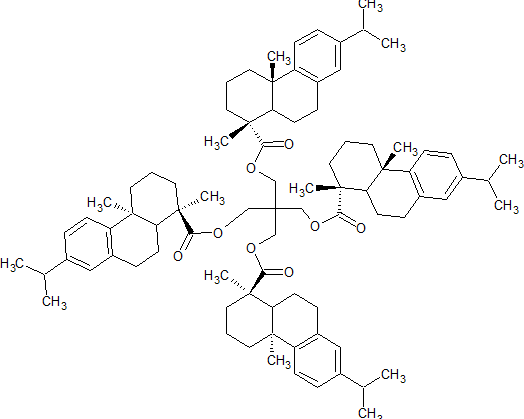
In order to obtain high-quality pentaerythritol rosin esters (with a color on the Gardner scale of no more than 3 and a softening point of no less than 101 °C), which are mainly used as adhesives in road marking compositions, the possibility of using disproportionated tall oil rosin as a source of resin acids with Gardner scale color no more than 2. The application of disproportionated rosin as a raw material made it possible to carry out the esterification in the temperature range of 260–270 °C which traditionally used in the synthesis of rosin esters without catalysts, technological additives, protective inert atmosphere and vacuum distillation. As a result, pentaerythritol rosin esters with high quality characteristics were obtained: color on the Gardner scale no more than 3, acid number no more than 10 mg KOH∙g-1, softening point no less than 103 °C. Similar esters of disproportionated tall oil rosin can also be obtained from other alcohols (methanol, ethanol, ethylene glycol and glycerol) and used as the basis for adhesive compositions and additives for various purposes, in which their color and its stability are important.
Downloads
References
Zhuravlev P.I. Kanifol’, skipidar i produkty ikh pererabotki. [Rosin, turpentine, and their processed products]. Mos-cow, 1988, 69 p. (in Russ.).
Golovin A.I., Trofimov A.N., Uzlov G.A., Zhukova I.P., Kiprianov A.I., Prokhorchuk T.I., Kovalev V.Ye. Leso-khimicheskiye produkty sulfattselluloznogo proizvodstva. [Wood chemical products of the sulfate pulp production]. Moscow, 1988, 288 p. (in Russ.).
Rowe J.W. Natural products of woody plants. Berlin; Heidelberg, 1989, 1243 p. https://doi.org/10.1007/978-3-642-74075-6.
Fiebach K., Grimm D. Ullmann's Encyclopedia of Industrial Chemistry. Weinheim, 2012, vol. 31, pp. 485–490. https://doi.org/10.1002/14356007.a23_073.
Bronnikova G.V., Kireyev R.I. Lesokhimiya i podsochka: obzor. inform., 1984, no. 2, pp. 12–32. (in Russ.).
Popova L.M., Ivanova V.A., Vershilov S.V. Khimiya rastitel’nogo syr’ya, 2019, no. 2, pp. 205–211. https://doi.org/10.14258/jcprm.2019023999. (in Russ.).
Zinkel D.F., Russell J. Naval stores: production, chemistry, utilization. New York, 1989, 1060 p.
Mahendra V. Appl. Mech. Mater., 2019, vol. 890, pp. 77–91. https://doi.org/10.4028/www.scientific.net/AMM.890.77.
Mardiah M., Samadhi T.W., Wulandari W., Aqsha A., Situmorang Y.A., Indarto A. AgriEngineering, 2023, vol. 5, no. 4, pp. 2155–2169. https://doi.org/10.3390/agriengineering5040132.
Hiscock K., Krajca K. Rosin ester handbook. Almere, 2007, 175 р.
de la Rosa-Ramírez H., Dominici F., Ferri J.M., Luzi F., Puglia D., Torre L., López-Martínez J., Samper M.D. J. Polym. Environ., 2023, vol. 31, no. 12, pp. 5446–5461. https://doi.org/10.1007/s10924-023-02949-0.
Xu Z., Lou W., Zhao G., Zhang M., Hao J., Wang X. Tribol. Int., 2019, vol. 135, pp. 213–218. https://doi.org/10.1016/j.triboint.2019.02.038.
Hardhianti M.P.W., Rochmadi, Azis M.M. Processes, 2022, vol. 10, no. 1, 39. https://doi.org/10.3390/pr10010039.
Patent Application 20160237313 (US). 2016.
Patent 11111411 (US). 2021.
Patent 10011740 (US). 2018.
Mahrous E.A., Farag M.A. Sep. Purif. Rev., 2021, vol. 51, no. 3, pp. 300–317. https://doi.org/10.1080/15422119.2021.1924205.
Papkov V.N., Rivin E.M., Blinov Ye.V. Butadien-stirol’nyye kauchuki. Sintez i svoystva. [Butadiene-styrene rubbers. Synthesis and properties]. Voronezh, 2015, 313 p. (in Russ.).
Papkov V.N., Gusev Yu.K., Rivin E.M., Blinov Ye.V. Butadien-nitril’nyye kauchuki. Sintez i svoystva. [Butadiene-nitrile rubbers. Synthesis and properties]. Voronezh, 2014, 218 p. (in Russ.).
GOST 17823.1-72. Produkty lesokhimicheskiye. Metod opredeleniya kislotnogo chisla. [GOST 17823.1-72. Wood chemical products. Method of acid number determination]. Moscow, 1999. 3 p. (in Russ.).
ISO 4630:2015. Clear liquids. Estimation of colour by the Gardner colour scale. Geneva, 2015, 6 p.
ASTM E28-18(2022). Standard test methods for softening point of resins derived from pine chemicals and hydrocar-bons, by ring-and-ball apparatus. West Conshohocken, 2022, 6 p. https://doi.org/10.1520/E0028-18R22.
Patent 9828526 (US). 2017.
Tolstikov G.A., Tolstikova T.G., Shul’ts E.E., Tolstikov S.Ye., Khvostov M.V. Smolyanyye kisloty khvoynykh Rossii. Khimiya, farmakologiya. [Resin acids from Russian forest conifers. Chemistry and pharmacology]. Novosibirsk, 2011, 395 p. (in Russ.).
Copyright (c) 2025 Chemistry of plant raw material

This work is licensed under a Creative Commons Attribution 4.0 International License.

This work is licensed under a Creative Commons Attribution 4.0 International License.
The authors, which are published in this journal, agree to the following conditions:
1. Authors retain the copyright to the work and transfer to the journal the right of the first publication along with the work, at the same time licensing it under the terms of the Creative Commons Attribution License, which allows others to distribute this work with the obligatory indication of the authorship of this work and a link to the original publication in this journal .
2. The authors retain the right to enter into separate, additional contractual agreements for the non-exclusive distribution of the version of the work published by this journal (for example, to place it in the university depository or to publish it in a book), with reference to the original publication in this journal.
3. Authors are allowed to post their work on the Internet (for example, in a university repository or on their personal website) before and during the review process of this journal, as this may lead to a productive discussion, as well as more links to this published work.